
On May 5th, our community will cast a vote either in favor, or against, the new high school project. There is a lengthy, ongoing, FAQ page at the Yes for Salem website.
BY Richard Jones, President, Jones Architecture, Inc & Nate Bryant, ED.D., Salem State University (Ret.)
Co-Chairs, Salem High School Building Committee
We have been honored to serve as the co-chairs of the building committee for the new Salem High School project for the last two years. Through this process we have learned so much about the challenges facing our district, our teachers, and our children and families. On May 5th, our community will cast a vote either in favor, or against, the new high school project. There is a lengthy, ongoing, FAQ page at the Yes for Salem website, www.voteyesforsalem.com, including the background, context, and links to past presentations and information about the project.

Here, we would like to focus on how the project is aligned with the principles of environmental justice (EJ). As an EJ community, how can a new high school support Salem’s community of individuals at or below 65% of the statewide median income? What can we do to support minority populations, and English as a second language constituents?
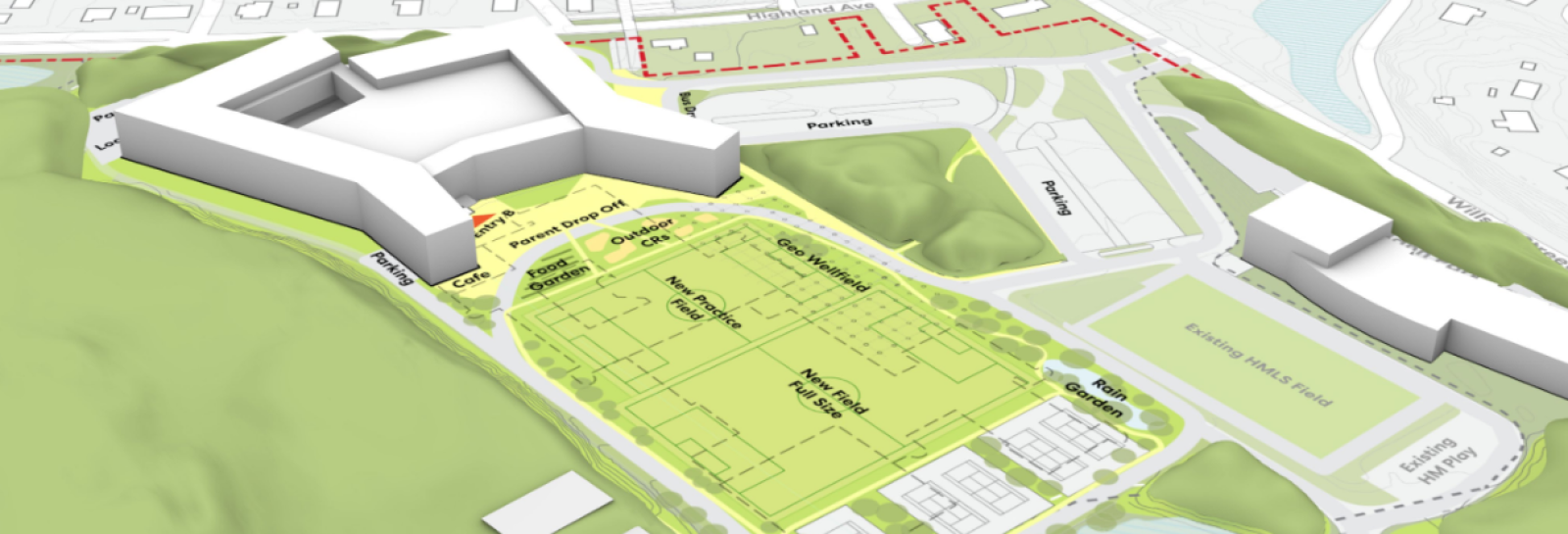
EJ starts with the principle that people have the right to be free from environmental pollution and live in and enjoy healthy environments. The existing building is served by original 1974 building systems reliant on legacy fuel sources (gas). The building envelope is substandard with little to no insulation, substantial leakage, and cold breaks running from inside to outside. The controls for the heating and cooling systems are vintage and essentially allow the systems to be on or off. As a result, the existing high school requires $1M annually to heat and cool, equal to almost 30% of the City’s budget allocation for utilities across its entire portfolio. The new building is striving for net-zero through a diversified energy supply including: geothermal wellfields, rooftop solar photovoltaic, and canopy solar photovoltaic over the parking area. Not only will this ensure less pollution, but it will create $1M annually in avoided cost in perpetuity, which can be applied to other needs.
Part of any school EJ policy should be meeting all students wherever they are. No matter income level, socioeconomic status, ability, neurodiversity, or other unique characteristics, the obligation of a school district is to educate the students and prepare them for life after high school. For some that means college prep courses, for others that means preparation for the workforce, and increasingly for many in our ever-changing job market, students take part in some of each. The current high school curriculum offers 27 AP courses, which puts Salem High School as a leader on the North Shore. In the last several years, the Career Technical Education (CTE) program has expanded from six disciplines to eight. Evening CTE programs for the community supplement this EJ mission. This has all happened despite the existing building not because of it. Current classrooms, labs, and performing arts spaces are too small and too outdated by today’s standards for flexible teaching models.These classrooms are saddled with the vintage building systems outlined above; students shouldn’t have to wear overcoats in the winter to learn.
Career Technical Education (CTE) plays a critical role in aligning education with workforce needs by providing students with real-world skills, industry credentials, and hands-on experiences that prepare them for both immediate employment and postsecondary success. At Salem High School, CTE participation has grown from 396 students in 2021 to over 640 students today, now serving nearly 70% of the student population, with over 90% of 9th graders participating in exploratory experiences. Additionally, more than two-thirds of students are engaging in both CTE and advanced academic coursework (including AP), demonstrating that students are pursuing multiple pathways. With postsecondary placement rates exceeding 94%, CTE ensures students graduate not only meeting requirements, but leaving with a diploma plus industry credentials, work-based learning experiences, and a clear plan for college and/or career.

The current total project cost is $447M; the MSBA grant is currently approved at $208M. The vote on May 5th is asking you to choose whether or not to accept this grant and increase property taxes to pay the mortgage on the loan for the balance of $239M or forego the grant and find another way to fund renovation of the high school which could cost tax payers 2 to 4X more.
What does a YES vote mean?
- Accepting the $208M Massachusetts School Building Authority (MSBA) grant.
- Modern academic and career technical education (CTE) spaces that support diverse pathways for our children, from college-bound to workforce-ready opportunities.
- Purpose-built, flexible spaces designed to adapt to rapidly evolving technologies and industry demands.
- A safer, healthier building for our children.
- A community resource that provides updated recreational, performing arts, and athletic field spaces for all.
- A Net-Zero building that relies on geothermal and solar photovoltaic energy. Today, the existing building runs an annual gas and electric bill close to $1M. With energy costs on the rise, this represents a considerable avoided cost for the city budget that can be applied to the debt.
- Increased property taxes for the period of the loan required to pay down the debt.
What does a NO vote mean?
- Turning away from the $208M MSBA grant. Re-entry to the MSBA pipeline for a renovation or other approach which could take up to five years or more and is not guaranteed. The MSBA has denied funding of renovation options at SHS in the past.
- No renewal of academic and CTE spaces. No expansion of CTE programs, which means CTE has already reached capacity. Despite expanding into redesigned classrooms and hallways, there will be no additional space to support growth or modernize programs to keep pace with new technologies.
- Seriously jeopardizing our accreditation. Accreditation is the most important credential that schools can receive, as it verifies educational quality, and ensures that a school meets recognized standards for curriculum, teaching, and safety. Further, it guarantees that diplomas are accepted by colleges, universities, and employers. The last accreditation review cited replacement of the high school building as a critical need. A loss of accreditation will impact our community, our property value, and our children, risking student and faculty attrition or flight.
- Renovations would still need to be undertaken not only to address the accreditation review, but to update code and accessibility deficiencies, failing building systems original to the 1974 construction, and other challenges. The cost of these renovations would still fall on the shoulders of the taxpayer.
- Increased project costs as renovations occur incrementally over the next 30 years. The construction industry sees an annual 3-5% increase in costs simply due to inflation; during the 2+ years of the pandemic this was 10-12%. If the construction cost is spread out over time, it will be a much larger burden on the taxpayer. This means that a $12M project in 2027 could cost $25-40M in 2057! That could increase the total price tag to $900M if the work is parsed out over three decades.
- Students, faculty and staff living in a constant state of construction. Phased renovation will be disruptive to learning and day-to-day life, risking further attrition.
- Although modest energy savings will be realized over time as renovations occur, the $1M annual utility cost will remain for some time as a continued drag on the City budget.
- Renovations funded by the City would draw down funding for other necessary projects – roads, sidewalks, infrastructure, police and fire vehicles, etc.
- Increased property taxes to fund improvements over decades will exceed the cost for new construction owing to the incremental approach, phasing challenges, and escalation of project costs over time.
We believe that the only answer is to vote YES for Salem.
Leverage $208M in grant funding. Create a sustainable solution that cuts into future utility costs. Address the accreditation gap, all at once, rather than trickling out over decades. Give our children the opportunities that they deserve so that they can be successful in our rapidly changing world and make Salem a more desirable destination for young families.