
Salem can learn some lessons from the experience on the South Shore
By Betsy Frederick
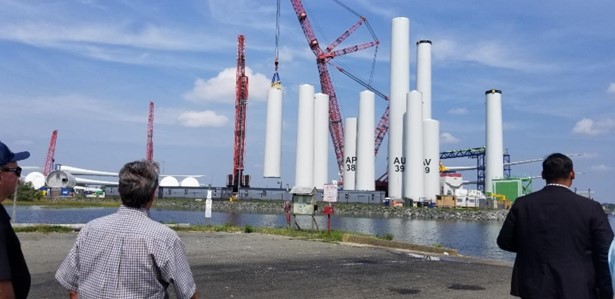
On September 5, 2023, SAFE joined a City Council site visit to the New Bedford Marine Commerce Terminal to observe operations at the only existing offshore wind marshalling facility in the Commonwealth. The Massachusetts Clean Energy Center (MACEC), the terminal operator and likely future owner of the Salem Offshore Wind Terminal, conducted the tour.


The New Bedford Marine Terminal is in a highly industrialized area, with no residential development directly abutting the site—a stark difference from the location in Salem, where homeowners are quite close by.
The site visit was an opportunity for Salem city officials and interested residents to observe a fully operational facility similar to the one proposed for our community and ask questions of the operator. We hoped to find out more about what the impact of port operations would be on our community.
New Bedford is currently operating at near-peak capacity. Though we were not allowed physical access to the facility grounds, we were able to see ongoing operations from the various vantage points, providing a good sense of what the future holds.
How New Bedford Differs from Salem
SAFE strongly favors the offshore wind terminal development in Salem, but we are working hard with other community stakeholders to ensure we have a strong Community Benefits Agreement that mitigates any negative impacts from construction and operations.
With that in mind, it was interesting to observe some notable differences between the New Bedford terminal and the future port in Salem. The New Bedford Marine Terminal is in a highly industrialized area, with no residential development directly abutting the site—a stark difference from the location in Salem, where homeowners are quite close by.
Another notable difference is that the Port of New Bedford has long been the nation’s highest-grossing commercial fishing port (by seafood value); as a result, the port is significantly more industrialized than Salem Harbor. In this regard, the surrounding community is possibly more acclimated to the nature of the activity (scale, schedule, light and noise) at the marshalling facility and is certainly more buffered in terms of physical proximity.
Finally, this facility is significantly more accessible from major roadways than the Salem facility. This means that neighborhoods that may be near the facility are not necessarily affected by vehicle traffic generated by the facility. Although a single visit is certainly not definitive, during our visit there were no vehicle back-ups or snarled conditions contributing to additional emissions at or near the site.
Because of the limited routes to the Salem facility, which require using local roadways, SAFE and its partners in Salem Offshore Wind Alliance (SOWA), have pushed for workers to use alternative transportation to arrive at the port area; for example, the facility could run shuttle vans to parking out by the North Shore Mall.
Port Activity
From the observation area, we watched as a large cargo vessel docked at the facility transferred equipment to another vessel. Workers were unloading turbine blades and moving them to storage on an abutting barge in preparation for transport to the wind farm location. Blades were approximately 350 feet (107 meters) and stacked on enormous racks. In addition, during the approximately one hour of the visit, the group could observe the slow movement of a dockside crane lifting one portion of a turbine tower onto the tower base unit. The operation was painstakingly slow for obvious reasons, with little noticeable noise associated with the activity.
Diesel Fumes and Port Electrification
One of SAFE’s concerns regarding port operations in Salem is an increase in diesel fumes from ships doing the kind of work observed in New Bedford. Diesel fumes cause asthma and other respiratory and heart ailments. That’s why SOWA’s community stakeholders are pushing hard for “port electrification,” whereby ships would operate with shore to ship power.
To prevent increased diesel pollution in neighborhoods close to the port, SOWA’s community stakeholders are pushing hard for “port electrification,” whereby ships would operate with shore to ship power.
As we observed operations, the Terminal operator confirmed upon questioning that the cargo vessel was still using its own diesel engines while in port. It seems the Port of New Bedford does not have an adequate electrical infrastructure to power the cranes necessary to lift the weight of the equipment being off-loaded.
Further questioning revealed that the port operator in New Bedford does not intend to provide adequate shore to ship power in the foreseeable future. It was unclear why, although the operator indicated that the power demands for these cranes are such that the ship itself has to provide this power. The ship was expected to be in port for approximately 48 hours during the entirety of which it would be operating on its own diesel engines.
The port operator described the ship and the equipment observed as “standard” and likely to be similar to ships serving the future Salem facility. SAFE does not feel that it is acceptable for these ships to be emitting diesel fumes during two- to three-day operations in the port. This is an area SAFE intends to more fully explore with Crowley and the City of Salem to ensure that electrical infrastructure will be adequate for the purpose of powering the specialized cranes in use at our future facility.
Salem is fortunate to have the opportunity to learn lessons from the developing port in New Bedford. Their experience with port electrification provided important information about the promise and obstacles. We’ll need to be vigilant to ensure the Salem port does not burden our community with a new source of air pollution.
Betsy Frederick is a professional planner with expertise in storm water management, and is a member of SAFE’s research working group.