
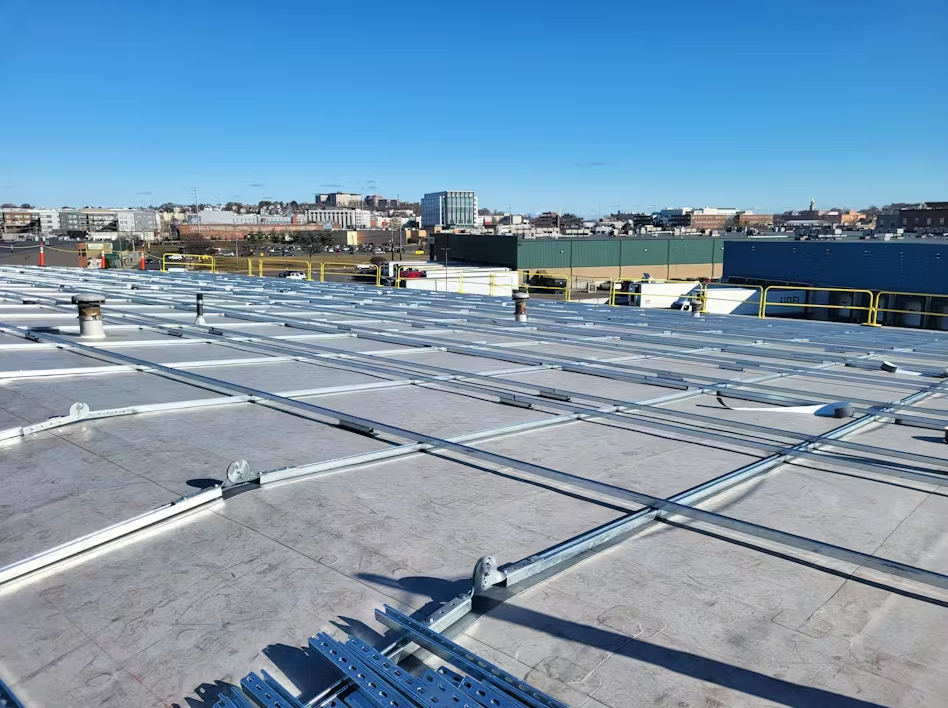
As communities across the state and the broader U.S. face worsening climate impacts, cities like Chelsea show that clean energy solutions don’t have to come from the top-down.
By KC Coryatt
The SAFE collaboration with the Tufts UEP graduate team brought our organization several case studies of community-owned energy. One example is the nearby City of Chelsea’s solar microgrid, which serves as a potential precedent for a newer Salem energy system. According to the case study report, solar microgrids are proving to be a useful tool in “building energy resilience, agency, and sustainability”. As communities across the state and the broader U.S. face worsening climate impacts, cities like Chelsea show that clean energy solutions don’t have to come from the top-down. The city’s journey towards a solar-powered microgrid offers Salem an example of what energy democracy can look like in action, as well as the potential challenges that remain ahead.
Almost a decade ago, in 2016, local environmental justice group GreenRoots partnered with organizations such as the Chinese Progressive Association, Clean Water Action, Climable, and Clean Energy Solutions to form the Resilient Urban Neighborhoods and Green Justice Coalition (RUN-GJC). Their goal: to explore community microgrids that would make Chelsea’s energy system more resilient, affordable, and community-controlled.
Chelsea has a predominantly Latine and immigrant population with many residents coming from, or having a lineage in, Central and South America. This population was a major reason for the prioritization of this microgrid project following the devastation of Hurricane Maria in Puerto Rico in 2017. This disaster and subsequent country-wide power outages hit close to home in Chelsea, where residents maintain deep ties to the Caribbean and were prompted to acknowledge the need for resiliency in the local energy infrastructure.
Community input was central, not an afterthought. Early on, a neighborhood survey gauged energy usage and resiliency needs, ensuring the project had buy-in from residents. Key buildings such as City Hall and the Public Works City Yard were selected for microgrid installation based on community input and vulnerability assessments. Future expansion could include affordable housing, public schools, and senior centers.

The microgrid project operates on solar energy stored in batteries to meet future energy demands. This allows each building to serve as a sort of “ energy island” that can function in the midst of emergencies like blackouts or major storms. It offers more than just emergency backup; the system reduces energy costs through solar credits and promotes community governance. As the project transitions from its current city oversight to a resident-led board, community members will have access to substantial decision-making power. This bottom-up power is a critical and essential step toward energy democracy and gives people more influence over their energy systems.

Like any bold initiative, Chelsea faces slow development. Bureaucratic hurdles, utility resistance (particularly from Eversource), and tariff-related supply chain delays all put significant pressure on progress. The funding for this project came from two state resilience programs: $650k from the Municipal Vulnerability Preparedness Program and $200k from the Green Communities Program. With City support, the project was able to receive an additional $3.6 million in funding, showing the success of municipal ownership in microgrid initiatives. To keep the momentum alive, funding must continue in spite of these hurdles. What Chelsea is building is more than a simple solar infrastructure, but a blueprint for other cities seeking to have more control over their power and, subsequently, their power bills.
This forward thinking is why Chelsea serves as a great example for Salem and SAFE to explore pathways to community-owned energy. The lesson? Success requires local leadership, adaptability, community involvement, and equity at its core. Energy systems should work for our people, not just around them. Find this case study within the report here (p.38).
Additional Sources gathered by Tufts Students:
Chelsea Record. 2024. “City Launches Solar-Powered Microgrid Project to Strengthen Energy Resilience and Sustainability.” November 28, 2024. https://chelsearecord.com/2024/11/28/city-launches-solar-powered-microgrid-project-to-strengthen-energy-resilience-and-sustainability/.
Cohn, Lisa. 2024. “Launched in Chelsea, Mass., Virtual Microgrid Concept Could Expand to Other Cities.” Microgrid Knowledge. December 9, 2024. https://www.microgridknowledge.com/distributed-energy/virtual-power-plant/article/55248333/launched-in-chelsea-mass-virtual-microgrid-concept-could-Expand-to-other-cities.
“Gaining the People’s Trust Helped Move This Virtual Microgrid Forward.” 2024. Green Justice Coalition. April 18, 2024. https://greenjusticecoalition.org/2024/04/18/gaining-the-peoples-trust-helped-move-this-virtual-microgrid-forward/.
Johnson, Marilynn. n.d. “Chelsea.” Global Boston. Accessed March 13, 2025. https://globalboston.bc.edu/index.php/home/immigrant-places/chelsea/.
Kavanaugh, Jennifer. 2022. “Chelsea Develops Microgrid for Public Buildings.” Massachusetts Municipal Association (MMA). January 12, 2022. https://www.mma.org/chelsea-develops-microgrid-for-public-buildings/.
Parshley, Lois. 2023. “The Little City That Could.” Mother Jones, 2023. https://www.motherjones.com/environment/2023/04/microgrids-chelsea-massachusetts-environmental-justice-climate-resilience/.
Power, Maria Belen. n.d. The Chelsea Project. Accessed March 13, 2025. https://www.massclu.org/the-chelsea-project/.
“Resilient Urban Neighborhoods + Green Justice Coalition (RUN-GJC).” 2021. Green Justice Coalition. January 15, 2021 https://greenjusticecoalition.org/news/community_microgrids-2/.
KC Coryatt is SAFE’s Summer Intern.