
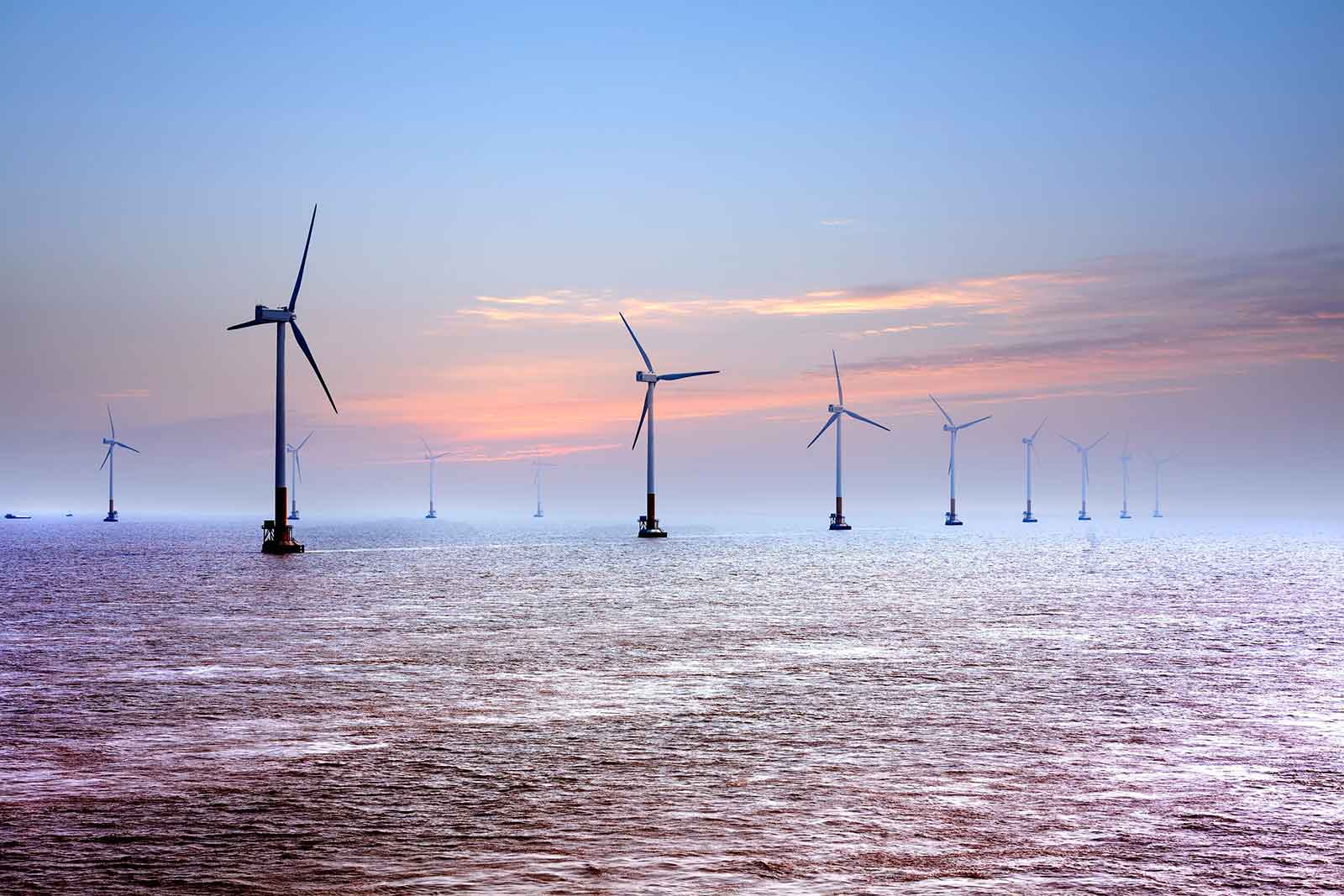
The North Shore has tremendous opportunities for growth in the coming years. The most exciting category of climate innovation in Salem is offshore wind, with the upcoming Offshore Wind Terminal promising to make Salem a player in the industry.
By Isaac Dame
The North Shore has tremendous opportunities for growth in the coming years. The region is a hub for climate tech research and innovation – an industry going through a period of 25% year-over-year growth, with millions in state funding coming down the pipeline (NMCC report). The most exciting category of climate innovation in Salem is offshore wind, with the upcoming Offshore Wind Terminal promising to make Salem a player in the industry.
As Tufts engineer Eric Hines articulated in our 2023 webinar, offshore wind has the potential to transform the New England economy. The Salem port’s lack of overhead or width restrictions means the massive heavy-lift vessels needed to build wind turbines can operate here, complementing the existing New Bedford Marine Commerce Terminal that serves smaller ships.
Meanwhile, there are manufacturing opportunities – the current offshore wind supply chain is based almost entirely in Europe, so there are opportunities for American manufacturers to scale up or create new ventures to meet growing needs (NREL report). Salem could be part of a network with New Bedford, build a connection with existing General Electric manufacturing in Lynn, build sub-components for wind turbines, while supporting the maintenance of offshore projects. Vineyard Wind is well under construction, several more projects are in the works off the shores of Rhode Island and the South Coast, and developers started buying plots in the Gulf of Maine last year (source).

Of course, there’s a big gap between future potential and present reality. The Trump administration’s attacks on the industry have caused project delays and led developers and contractors to avoid publicity. Construction on the Terminal has not started, and it is hard to know what will come next. But even in an uncertain industry, there are innovators we can learn from. The aforementioned New Bedford Marine Commerce Terminal is a wing of the Port of New Bedford specialized for offshore wind and currently used as the support hub for Vineyard Wind. The strengths and limitations of this project can be a lesson for Salem going forward.
The New Bedford wind port was constructed in 2015 and expanded in 2017 and 2022. The normal operation of the Terminal involves a developer project team, union laborers, rope technicians, marine operators, and security staff, resulting in a steady stream of activity at the port. Construction companies working on the site describe the most activity they’ve seen in years (source). In addition to construction, marine services, and the trades, support industries such as equipment stores, cleaners, and hospitality are all experiencing growth in their business.
Additionally, the region benefits from the work of the New Bedford Ocean Cluster, a non-profit that follows an Icelandic model of marine business collaboration to connect local businesses to contractors (source). The videos linked above feature local companies they’ve worked with at the Terminal. Offshore Wind makes up one pillar of their work, with the others being Aquaculture, Commercial Fishing and Processing, and Innovation and Technology. For each pillar, a network is created to bring together disparate parts of the industry to effectively develop efficient and sustainable practices. The Ocean Cluster can serve as a central hub bringing together stakeholders in each industry as needed while still maintaining a focus on each pillar’s distinct circumstances. In particular, offshore wind has a unique set of challenges.

Any development project can encounter issues with permitting, financing, and timelines. Still, due to the novelty of offshore wind and controversy around it, these projects typically have vague, decade-long timelines (NYSERDA source). Vineyard Wind began finding a site in 2010, agreed on a lease in 2015, and completed environmental review in 2021 after several delays (source). Construction proceeded, and the first turbines went live in 2024, but a blade failure led to cleanup and more delays (source). While construction has resumed and turbines are live, these delays have complicated work at the Terminal and made it hard for other industries to prepare.
Developers and top contractors are based in Europe and are likely to work with existing national partners. There are few companies in Massachusetts with offshore wind experience, so contractors favor national-scale American partners they’ve worked with before. This can be countered with legal requirements – in New Bedford, Vineyard Wind’s contract stipulates they hire “local” companies – but this can only do so much if a local supplier does not exist.
However, the industry is aware it will need local partners to increase efficiency, so an effort is being made to promote future development. An offshore wind industry organization, the Oceantic Network, maintains a database of companies that could be part of the supply chain, and Southern Massachusetts is well-represented. Many of these suppliers and service providers have not worked on a wind project, but have shown their enthusiasm to enter a new space.
The structural issues that already exist in Massachusetts are also present in offshore wind. Almost all of New Bedford is considered an Environmental Justice community, meaning a minority population over 40%, and/or more than a quarter of households having an income 65% less than the state median, and/or more than a quarter of households having no one over 14 comfortable in English. These statistics reflect significant economic and cultural obstacles that will factor in to any local development. In this context, it’s notable that the New Bedford Ocean Cluster has worked to bring in local Black, immigrant, and women-owned businesses and created a Diversity, Equity, and Inclusion Committee to address these gaps.

Salem may have a smaller port and a unique history compared to New Bedford, but there are many similarities worth noting. Like New Bedford, Salem is heavily made up of Environmental Justice communities, and we have local companies that are interested in adapting their business for the incoming industry. Unlike in New Bedford, no Ocean Cluster is serving as a direct liaison between small businesses and developers. However, thanks to our community effort as the Salem Offshore Wind Alliance, Crowley agreed to a Community Benefits Agreement (CBA). The CBA is a stronger contractual agreement that requires them to meet hiring requirements for local, BIPOC, women, and union labor, to work with local businesses, and to support Salem Public Schools’ Career and Technical Education (CTE) programs. As a result, by March of this year, over 25 North Shore companies had connected with the developer for catering, landscaping, marine work, and more (source).
In addition, collaborators and leaders in the North Shore joined with the North Shore Alliance for Economic Development (NSAED) to create the Northeast Massachusetts Climatetech Consortium. The Consortium will assist local businesses making a switch to climatetech and promote underserved business leaders. Workforce development remains a challenge, but a program through MassHire and Essex Technical Institute trains tradespeople with relevant skills for clean energy (source). It’s also worth mentioning NSAED’s work to bring in businesses with owners from underserved communities. They’ve built a Diversity Directory to serve as a resource to highlight these businesses in the North Shore. It was built as an expansion to the now-defunct official North Shore Diversity Catalog and serves as a limited but valuable tool to place a spotlight on local strengths.
There are smart and engaged people positioned to make opportunities accessible in Salem. Learning from the New Bedford Terminal’s example, we see that there will be opportunities for support industries in the immediate future, with laborers and raw materials suppliers active shortly after more contracts are agreed. There is a need to connect local businesses and workers to developers and contractors through an Ocean Cluster or the existing North Shore Alliance. Contractual agreements are key to holding developers accountable, and the CBA is a very effective tool in our belt. While the industry is chaotic and uncertain, we can make good things happen if we keep our partnerships strong, skill up, and keep up the good fight.
Isaac Dame is SAFE’s Summer Intern.