
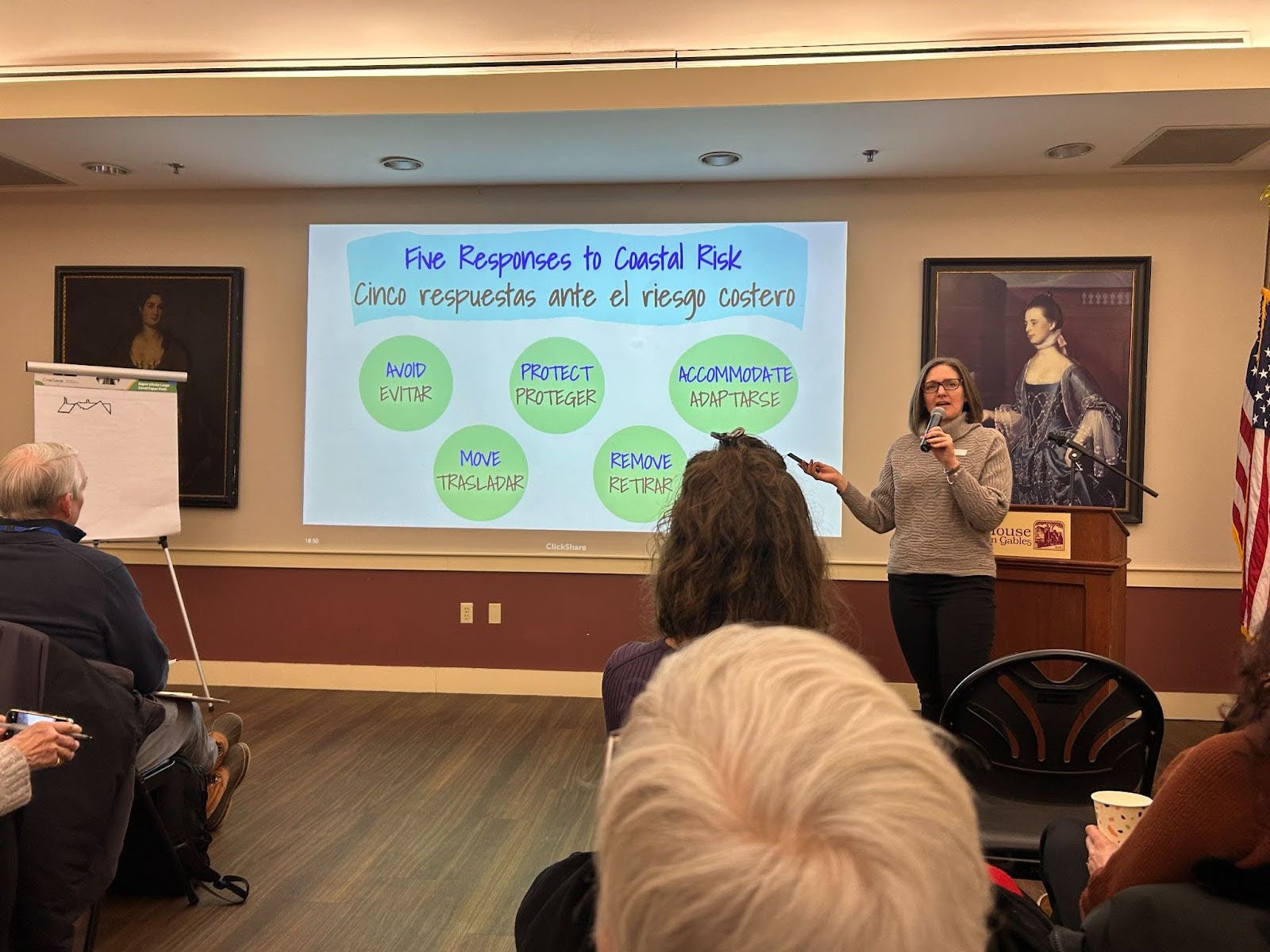
On February 9th, SAFE partnered with Crew and the Nature Conservancy to host a Coastal Resilience and Relocation event.
By MIa Amaral
Community members gathered to discuss coastal resilience and relocation on the local and state levels. The event featured interactive elements and guest speakers from organizations such as Communities Responding to Extreme Weather (CREW), The Nature Conservancy, CH Consulting, the MA Coastal Zone Management, and Salem’s Sustainability and Resiliency Department. The House of Seven Gables graciously hosted us in their space, and we held this at the Historic Derby Street Neighborhood Association’s regularly scheduled gathering. With the support of neighborhood groups, civic associations, and the North Shore Community Development Coalition, our outreach extended to many residents.

The event focused on five responses to coastal flood risk: avoid, protect, accommodate, move, and remove. The first response, avoid, entails avoiding building structures within risky areas, such as those that have a high potential for coastal flooding. Conversely, protecting involves building defenses to protect pre-existing infrastructure. This way, we can preserve our current infrastructure against the rise of sea levels. Accommodating entails finding ways to live with the flood risk. This involves accepting that the land around certain infrastructure will flood, and we can respond by making temporary changes. Additionally, moving existing infrastructure out of the way and to a safe area mitigates flood risk. Lastly, removing structures prevents future generations from encountering flood risk by returning to nature. Buildings can be entirely removed within flood zones, and allow for nature to reclaim the space.

An alternative response to coastal flooding is to plan for relocation. Relocation involves participating in collective action, focusing on community and not individual responsibility. Additionally, relation strategies can be future-oriented, focusing on building or unbuilding to fit a community’s vision of the future. These strategies should be action-oriented, not reactionary, as it puts time on our side, allowing for communities to prepare, rather than respond to a crisis.
After the conclusion of our event, community members shared their reactions, thoughts, and impressions of the information they were presented. Some reflected on the implications of flooding for property ownership and renting. Homeowners reported not being told when buying that their property was in a high flood zone, and that knowing this information would have caused them to rethink their decision. Other participants reflected on their families. One participant, being a fourth-generation Salem family, has witnessed the increased flooding within the city, noting how this jeopardizes the safety of their property and family. Lastly, another participant shared concerns about those who rent properties. Many of the flooding response strategies are centered around those who own their own property. Renters may not be afforded the same ability to respond as property owners.

The event was a great way for concerned residents of Salem to discuss coastal relocation and resilience, and learn what they can do in the face of sea level rise. With more events like these held in areas that are at risk for increased flooding, more people can be prepared for the impacts of flooding, as well as be able to take action to mitigate harm and damage.
Learn more about proactive relocation for Massachusetts Coastal Communities here
View the Massachusetts coastal resilience and relocation story map here
Take the coastal resilience and relocation survey here
Mia Amaral is SAFE’s Programs Intern.