
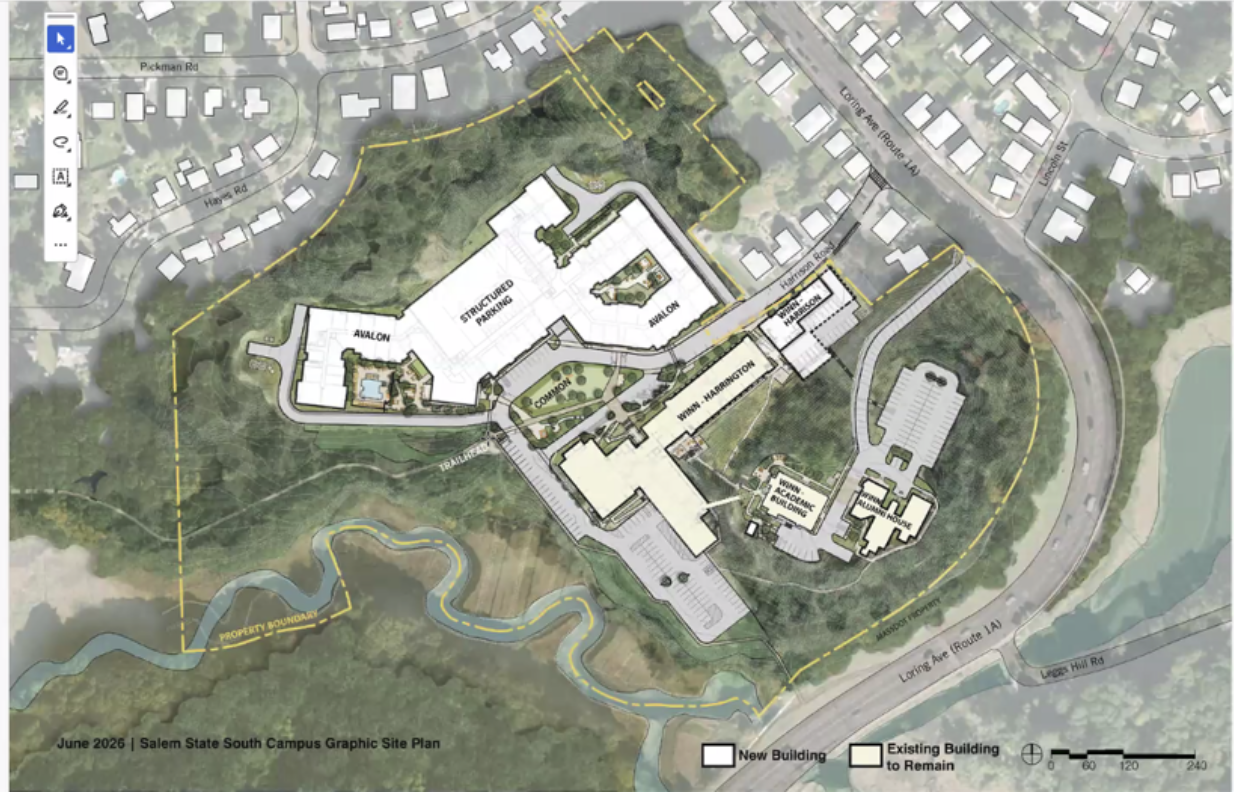
Picture: Site plan from the original Winn/Avalon bid
Written by Alyssa Rosemartin
The Forest River Conservation Area (FRCA) is one of Salem’s hidden gems. I have hiked the trails hundreds of times – daily during the first years of the pandemic. I have spent time with wood ducks and vireos, fishers and fiddler crabs. This summer, Eagle Hill was blanketed with the pink flowers of rock harlequin, a plant that thrives post-fire. Changes are coming to the trailhead and riverfront with the sale of the 23-acre South Campus property by Salem State University to Winn Development and AvalonBay Communities. The purchase includes portions of the trail and river, and the trailhead.

Photo: Rock harlequin blooming on Eagle Hill in Forest River Conservation Area
This project represents an exciting redevelopment, one that is well-aligned with Salem’s Housing Roadmap, and leverages the 40R, Smart Growth process. Salem will see more housing – market-rate housing, senior housing and affordable housing through this project. On the Avalon side (subzone 1, on the right as you enter from Harrison Road, where dorms and parking are currently) there will be 340 apartments and a parking garage. Of these units, 10% will be affordable at 80% AMI and 10% affordable at 60% AMI. On the Winn side (subzone 2 and 3, on the left as you enter the site, where the Harrington and Alumni buildings are currently) there will be over 100 units, the majority designated senior housing. Of these, 40% will be affordable at 60% AMI. Subzone 4 comprises the riverfront and trail access and is zoned undevelopable.

Picture: The SSU South Campus has been divided into four zones.
In January 2026 the Winn/Avalon sought approval from the Conservation Commission for their construction plans. They included limited trailhead improvements and native plantings. They said it was not feasible to have a trail connector to Loring Avenue, essentially retracting what they had proposed in their 2023 bid. As a community who wants ‘complete streets’, walkable, connected neighborhoods, and wheelchair accessible trails (this entrance to FRCA is the only wheelchair accessible entrance), we had to take action. Through robust public comment, site visits, letters from neighbors and organizations, including SAFE, our community secured several important enhancements to the FRCA riverfront and trail access.
The Order of Condition for the project codifies:
- The terms of the easement with the State of Massachusetts, ensuring public access in perpetuity.
- The development of a connector trail from the FRCA Trailhead to Loring Avenue.
- A standalone Invasive Species Management Plan.
- An escrow account with $50,000, which is returned to the developer upon successful completion of invasive removal and native plantings.
- Interpretive signage developed in collaboration with Indigenous communities and approved by the Conservation Commission.
- The Order also includes designated public and disabled parking, a dog waste station and bike rack.
Many people who love FRCA and affordable housing will keep watching to ensure that these commitments are honored. To learn more about the process to win these commitments from the developers and the ongoing process to restore the Volunteer Bridge within FRCA, visit this site.
Reflecting on this effort, I think we should more often join together to secure strong commitments from developers, as so beautifully modeled by SAFE and the Community Benefits Agreement for the Offshore Wind Marshalling Yard. We can also look to Peabody for inspiration, where the community recently won a commitment for developers to build a walking trail, kayak rack and boat launch (for the yet-to-be finalized 60 Pulaski St project). I hope that future SmartGrowth overlay projects rise to meet the vision of walkability, natural and historical connections, and housing at many price points. We could support projects that increase or restore marsh, with development moved up and inland, increasing future climate resilience.
We can dream bigger – what if outside private capital were not always necessary to get the housing we need and deserve? I am inspired by Community Land Trusts, where a governmental or non-profit organization owns the land, and people are able to build and own the housing on that land for less. In this scenario, the returns on investment never leave the community. We could look as far as the Sogarea te’ Land Trust in California or as close as the Comunidades Enraizadas Community Land Trust in Chelsea for examples. Further, conversations around the “deed” to the City of Salem and the Native Spaces project invite us to explore the meaning of land ownership and how we might restore our relationship to land and each other.