
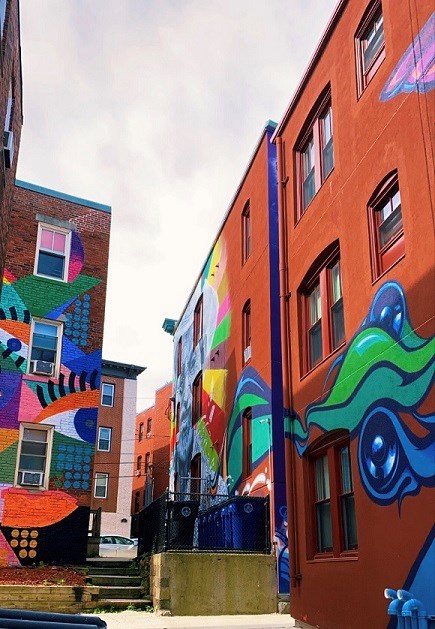
Image of The Point neighborhood in Salem
Primes Group’s proposed IT facility at Shetland Park became the center of controversy in Salem when city officials determined that the project was intended to function as an artificial intelligence (AI) data center. Although the developer disputed this characterization, describing the facility as a “low-latency inference point”, the disagreement raised broader questions about the environmental impacts of AI infrastructure, the limits of zoning regulations and the responsibility of communities to protect their residents and resources.
AI data centers require substantial amounts of electricity to power computing equipment and keep servers cool. Depending on their cooling systems, they can also place significant demands on local water resources and release considerable amounts of waste heat. These impacts are particularly concerning in communities that are already vulnerable to extreme heat. In Salem, this raises questions about how a facility of this scale could affect residents of The Point, also known as El Punto, and whether the potential environmental consequences have been adequately considered.

Graph from “Extreme Heat in Salem” Research Project by Nicholas Geron (SSU) (2025)
The Salem Building Department revoked Prime Group’s building permit, citing concerns about the proposed facility’s scale and zoning restrictions that prohibit AI data centers in the district. Prime Group subsequently appealed the decision, but the Zoning Board of Appeals voted to uphold the permit revocation. A few weeks later, the Salem City Council considered changes to the city’s ordinances to clarify how data centers are defined and regulated.
The goal was to prevent companies from getting around restrictions by describing their facilities as something else or dividing their operations among different businesses. At the same time, the city sought to protect local businesses that rely on smaller data servers; for example, hospitals, emergency services, and local businesses may rely on servers to store records, manage operations and process information. Some services including emergency response systems and certain medical tech may also benefit from nearby computing infrastructure that allows the data to be processed quickly without delay. However, the concern for the proposed facility at Shetland Park was not simply that it would house computer servers, but that its expanded plans included substantially more power generation and cooling infrastructure to support its intended operations, heavily increasing its heat output on the surrounding vulnerable community of El Punto. This raises a much bigger question: how can communities ensure that residents are informed about development projects and have a meaningful voice in decisions that affect their lives?
This question is especially important in our fight for environmental justice as we need to consider who is most likely to experience the consequences of environmental decisions. The Point is a predominantly Latino community where Spanish is widely spoken. Yet, when important discussions about development and its potential environmental impacts take place primarily in English, residents who speak Spanish may face additional barriers to accessing information and participating in the decision-making process. When people cannot easily understand what is being proposed in their own neighborhood, they are placed at a disadvantage when it comes to advocating for their families and community.

Image of Brazilian protestor’s sign for Climate Justice for UN Campaign
Environmental justice is not just about preventing environmental harm. It is also about who has access to information, whose concerns are taken seriously, and who gets to participate in decisions that shape their future. If residents are left out of these conversations because of language barriers or limited access to information, existing inequalities are reinforced. A community should not have to fight to understand what is happening in its own backyard, especially when the decisions being made could affect its health, resources, and quality of life. The debate over Salem’s proposed data center is an opportunity to reflect on what meaningful community participation should look like. This means making information accessible in the languages residents speak, creating opportunities for people to ask questions and express concerns, and ensuring that community input is considered before decisions are made. It also means looking beyond the economic benefits a development might bring and asking who benefits, who bears the risks, and whether those risks are being distributed fairly.

Thermal drone images of the data collected for the High Heat project conducted by Salem State University.
Building a more environmentally just Salem requires more than strong zoning regulations. It requires a commitment to making sure that all residents, regardless of language or background, have the opportunity to understand, participate in, and influence the decisions that affect their neighborhoods. We cannot work toward environmental justice without centering the voices of the communities most affected by environmental decisions. A stronger community is one where residents are not simply informed about changes after the fact, but are treated as essential participants in shaping the future of the places they call home.