

The Installation
Salem Alliance for the Environment plans to install ten PurpleAir air quality monitors. The City of Salem is getting an additional five that are going directly to schools in Salem. The air quality monitors were funded through the Massachusetts Department of Environmental Protection; The North Shore Community Development Coalition, the City of Salem, and SAFE all requested and received 5 monitors.
SAFE’s ten will be dispersed throughout the city, with one going to the House of Seven Gables, one going to St. Peters Church (Due to their environmental commitment with the Heaven and Earth Project), and the rest going to areas of El Punto and the Salem port. SAFE is recruiting Ward Councilors, community members, teens from the Salem Youth Commission, and any other interested volunteers for help in the installation process.

These monitors will allow us to discover patterns in exposure to poor air quality at these sites. We suspect this will include proximity to cars, development, and port operations. While it is difficult to make data readily accessible to residents, PurpleAir monitors use an index and color scale to display air quality levels. These are likely the same standards that your weather app uses when displaying the current air quality. The current AQI (Air Quality Index) color is visible directly on the sensor, so community members can simply visit their nearest sensor to check the local level of particulate matter.


If you check PurpleAir’s Air Quality Map (Map Link – Salem), you can easily find data from the air quality monitors. For example, here are some screenshots from the House of Seven Gables’ monitor on the map.


Health Impacts
Countless illnesses can be sourced from poor air quality, with particulate matter and dangerous compounds entering through the respiratory system. According to the World Health Organization, almost every organ in the body can be affected by poor air quality. Some medical outcomes that are at most strongly linked to poor air quality are stroke, ischaemic heart disease, chronic obstructive pulmonary disease, lung cancer, and pneumonia. Additionally, there is suggestive evidence that links cancer, medical issues associated with pregnancy, diabetes, and neurological diseases.1.
When looking at demographics of people that are most at risk from poor air quality, these include children, pregnant women, and the elderly. However, while health consequences follow a pattern of age and pregnancy status, exposure is anything but equitable.
Oftentimes, the most underserved communities are the ones that are harmed the most by poor air quality. People of color are disproportionately exposed to particulate matter, which describes small dust-like particles that can enter the lungs and even the alveoli, causing extensive damage to the respiratory system.
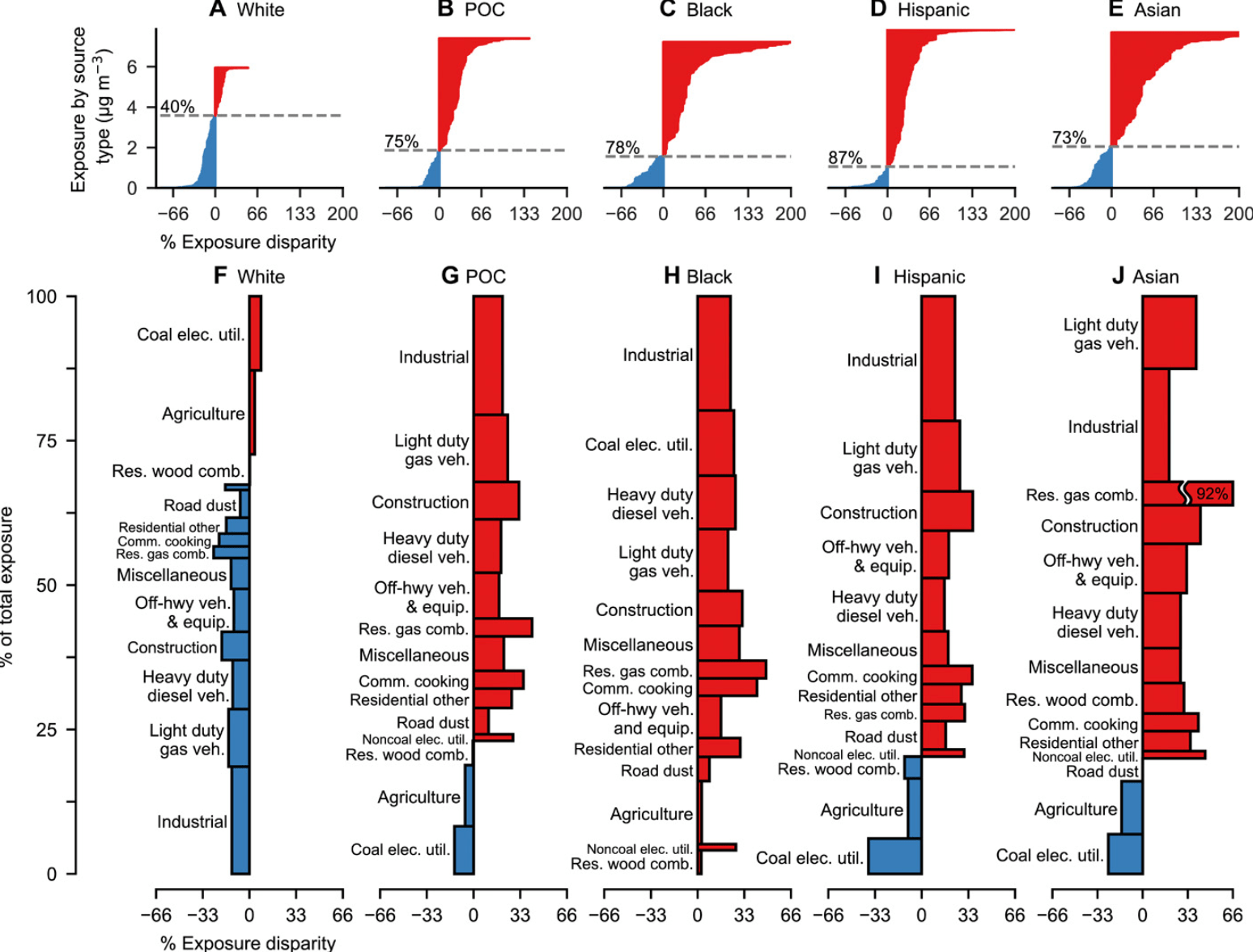
This study was a census based analysis of average race-based air quality exposure, sourced from residential location. The data shows a clear trend, that neighborhoods predominantly inhabited by residents of color experience greater levels of air pollution. At the same time, these neighborhoods are also less likely to receive adequate medical treatment. Hispanic and African Americans are more likely to be uninsured throughout adulthood than other races. Receiving healthcare without insurance is far more difficult, as many medical treatments require insurance or result in incredibly high medical costs.3.
As a gateway city, Salem has a higher population of people of color than its surroundings. 46% of El Punto residents are from the Dominican Republic, and 26% of Salem households do not speak English as their primary language (35% in El Punto).4. Salem is also defined as an Environmental Justice community, which marks that Salem’s income distribution and location make the city more vulnerable to environmental impacts, air pollution included. With these risks acknowledged, it is our responsibility to ensure that Salem’s history of poor air quality does not define its future.
Community Distribution
This means that monitoring how air quality is dispersed throughout Salem is critical to improving racial and location-based equity. If Salem Alliance for the Environment can collect reliable information and disperse it to community organizations, residents, and city planners, actions can be taken to mitigate exposure and health impacts. For this reason, many of the air quality monitor installs are designated for areas of El Punto. Additionally, we recently installed four heat monitors in different areas of El Punto, allowing us to better understand how heat varies across Salem neighborhoods. Check out this blog for more information. [Insert link]
Sources
- Health Impacts, World Health Organization https://www.who.int/teams/environment-climate-change-and-health/air-quality-energy-and-health/health-impacts
- Christopher W. Tessum et al., PM2.5 polluters disproportionately and systemically affect people of color in the United States.Sci. Adv.7,eabf4491(2021).DOI:10.1126/sciadv.abf4491
- Health Coverage By Race and Ethnicity, kff.org https://www.kff.org/racial-equity-and-health-policy/health-coverage-by-race-and-ethnicity/
- Salem Point Vision Action Plan, Metropolitan Area Planning Council https://www.mapc.org/wp-content/uploads/2017/10/SalemPointVisionActionPlanEnglish_FINAL_2013.pdf