
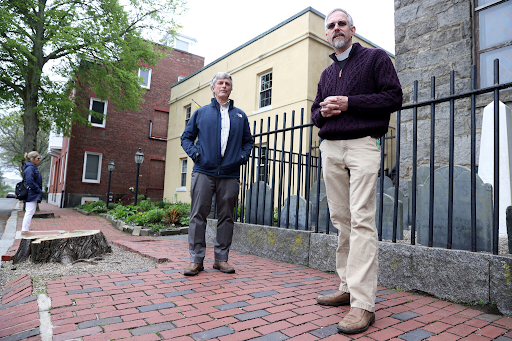
Rev. Nathan Ives of St. Peters Episcopal Church is leading the charge on working to reshape how the historic downtown heats, cools, and powers key public and private buildings through the Heaven and Earth Project.
By KC coryatt
The church, founded in 1733 as the first Anglican church in Salem, and mentioned in Nathaniel Hathornes classic “The Scarlet Letter”, is located in the center of Salem’s historic district. It is surrounded by residential, commercial, and multifamily structures as well as key buildings such as the National Park Service and the Peabody Essex Museum. This project was sparked in 2022 when the Reverend received a shocking bill from National Grid — a $2,900 gas bill increase overnight. This sudden cost atop of the $10,000 annual gas fired steam boiler repair was the final push and impetus for the church to take action. The church serves as a central social hub, providing support for the community through programming such as Meals at Lifebridge Shelter, Mamás Unidas diaper drives, AA meetings, a free winter coat closet, and community conversations. Soon after this absurdly high bill, the creation of a coalition set on bringing clean, reliable energy to Salem, Massachusetts through solar microgrid (Heaven) and geothermal (Earth) projects began. Having dependable energy doesn’t only serve the church building itself, but provides respite for community members.
As we’ve looked at other case studies across the country, we want to look inwards back at the advancing work that is happening here in Salem.

The Heaven portion of the project seeks to implement a solar microgrid atop the almost 200 year old granite church, constructed in 1833 after replacing the original wooden church building. To get this concept started, the church collaborated with Clean Energy Solutions Inc (CESI), an energy consulting firm that has worked with neighborhoods such as Chelsea and Chinatown in starting up a microgrid project. The proposed grid would generate energy and store it within batteries– providing continuous energy even in the case of a power outage or extreme weather events. Independent power generation would allow the church to have reliable energy to cool down, keep essentials such as medication refrigerated, maintain connection via phone and internet and take some of the strain off of the traditional grid by assuring that needed power remains accessible to nearby residents year-round. Annually, solar power will allow St.Peter’s to save about $61,000 on energy and remove about 227 tons of carbon from its footprint, contributing to cleaner air.
The church’s partnership with CESI highlighted the commitment to environmental justice and the goal of uplifting and giving deep meaning to community involvement and engagement in the process of transforming the church. CESI lists their main goals as:
- Ensuring energy resilience for the congregation and residents of El Punto
- Securing financial stability by reducing the operating costs for energy
- Aim towards net-zero for St.Peters
This project serves not simply to lower the operating costs for the church but to create a resilience hub that can support the Salem community in times of need. As Salem’s largest Environmental Justice neighborhood, El Punto residents are the focus for fostering a sense of ownership and eventual management of the resilience hub. The project highlights the focus on co-design and the desire for community involvement. By electrifying its power needs, St.Peters will be able to open its doors for residents to use and rely on during hot or very cold days.
The Earth aspect of the project involves geothermal heat pumps that heat and cool nearby residences. These systems move heat from one place to another using a series of pipes buried in the ground that circulate water mixed with antifreeze that absorbs or deposits heat into the surrounding soil. St.Peters received a $50,000 Kickstart grant from HEET, a nonprofit dedicated to transitioning from gas to thermal utilities, that allowed the church to begin development. In collaboration with Larry Lessard — the technical lead of Achieve Renewable Energy, a Salem-based geothermal company, and B2Q Associates, their engineering partner — St. Peters has been able to conduct a feasibility study for constructing a “community-owned, network Geoexchange system”. The proposed mile loop, about 20-30 feet below ground, uses the fairly constant temperature of the soil to keep structures cool in the summer and warm in the winter. Lessard reported that the savings in GHG emissions for 2050 will be substantial with this switch. Cost savings could be reduced between 17-18% for 2050 with this switch, considering conservative estimates for critical facilities.

Rev. Ives didn’t work in isolation. A coalition of local stakeholders including private property managers, Salem Housing Authority leaders, and municipal officials was built. Ives reported being “surprised and pleased” by how many neighbors supported the concept during one-on-one outreach at a recent HEET Kickstart meeting hosted by the MAPC. The Heaven and Earth project by St.Peters Church not only holds climate justice at its heart but community ownership and involvement–aiming to marry resilience, sustainability, equity, and community collaboration. SAFE sees the project at St. Peter’s as an invaluable exploration into a just energy future for Salem.
KC Coryatt is SAFE’s Summer Intern.