
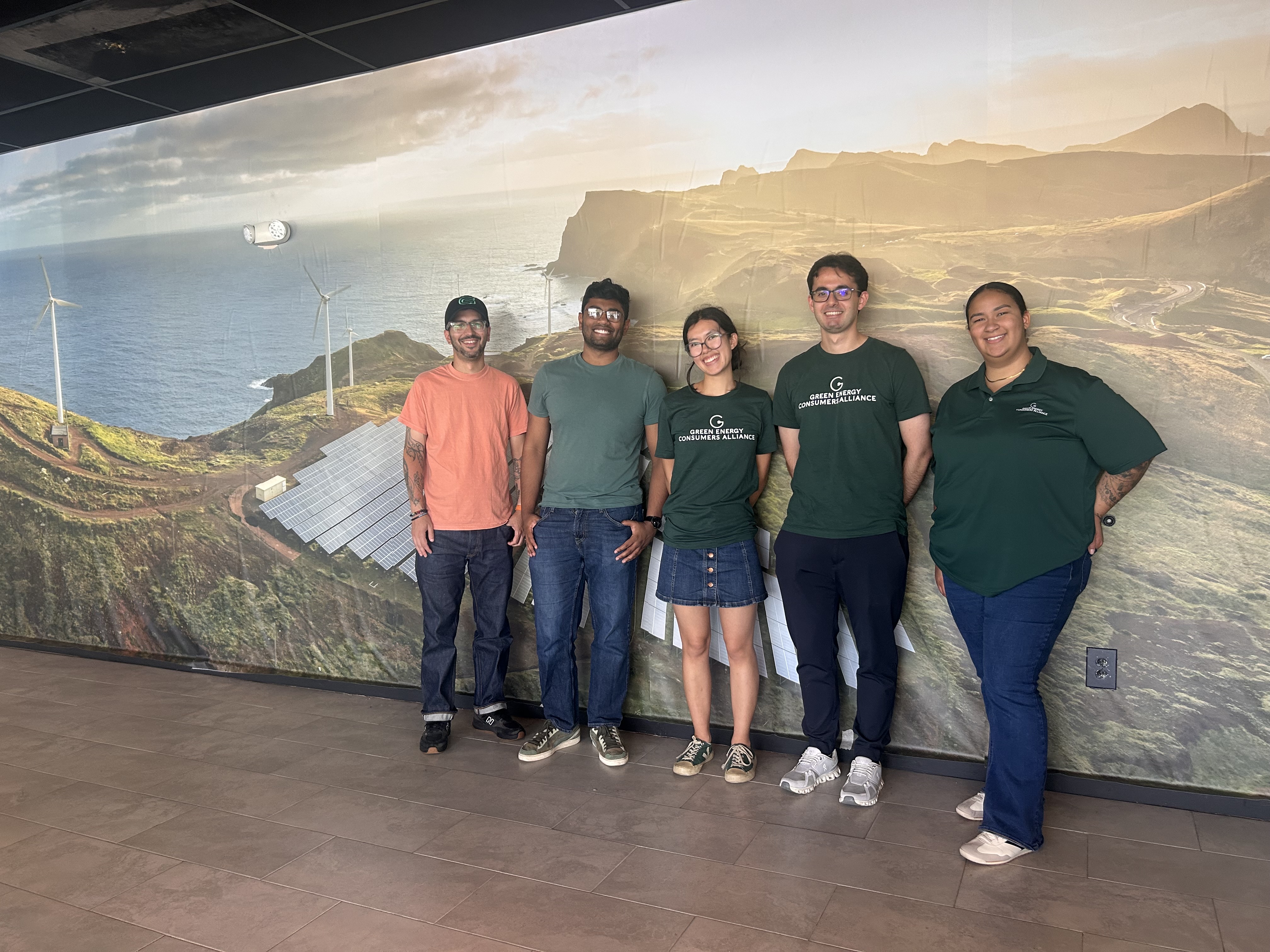
Above, in orange, Andrew, Green Wave’s Salem location manager. In green, the Green Energy Consumers Alliance team at the event.
On Sunday the 29th, SAFE, the Green Energy Consumers Alliance (GECA), and Green Wave Electric Vehicles teamed up to host a Community Conversation on Electric Vehicles. The plan was to have GECA present about EVs and EV rebates provided by the MOR-EV program and then a tour of the Green Wave showroom where Green Wave employees could answer attendees’ questions. Green Wave EV is a used electric car dealership with locations in both Salem, MA and North Hampton, NH whose mission is “to accelerate the decarbonization of our economy and create a more sustainable society by providing re-used electric vehicle solutions to people and businesses in the communities we serve.” They envision “a world in which all people who want a more sustainable vehicle can have one that fits their budget and their lifestyle” (Green Wave EV About page). GECA is a non-profit based in Massachusetts and Rhode Island whose mission is “to empower consumers and communities to speed a just transition to a zero-carbon world. [They work towards their] mission through green energy education, programming, and climate advocacy” (GECA About page).
GECA presented a slideshow about how electric vehicles can be affordable with the right strategy. GECA suggests taking advantage of Massachusetts’ electric vehicle rebate program called MOR-EV, which stands for Massachusetts Offers Rebates for Electric Vehicles. Below we go through the different types of rebates available and what is required to qualify for them.
Vehicles that are covered for the rebates
There are 3 different types of electric vehicles: battery electric vehicles, which are fully electic vehicles; Plug-In Hybrid vehicles, which have both a battery and a gas engine and can be plugged in to charge; and Hybrid vehicles, which have a gas engine that charges an electric motor and cannot be charged externally.

The three types of electric vehicles
So which ones can you get using the rebates? MOR-EV rebates can only be redeemed when purchasing or leasing fully electic vehicles, not hybrids. The EVs can be either new or used, which allows for more consumer flexibility. They can be received for many different classes of vehicles, including light-duty, class 2 trucks, and classes 3-8 heavy-duty vehicles. See the full details below in the image of the table titled “MOR-EV Rebates and Rebate Adders”.
See below the Rebate Options

English Language version of the rebates table

Spanish language version of the rebates table

A slide depicting the various rebates in English and Spanish
This slide in the GECA’s presentation highlights how much money someone can get from each possible rebate. For standard light-duty vehicle purchases or leases on new or used cars, a rebate of $3,500 can be obtained. On top of that, individuals who qualify on an income-based standard receive an additional $1,500 to offset the cost of purchase. If a gas-powered vehicle is exchanged for an electric one, an additional rebate of $1,000 is available.
Addressing Concerns
The presenters also addressed many concerns about electric vehicles. When asked about the cost to charge, the GECA used multiple credible statistics to show that electric vehicles save around $0.07 per mile driven. While this may seem like a small difference at first, over the lifespan of an electric vehicle, this could result in anywhere from $7,000 to $21,000 in savings.1

Graphic showing the savings per mile earned having a battery-powered EV versus a gas-powered car

Graphic comparing how far one can travel with $4.20 worth of power with a gas car versus an EV (This was calculated when a gallon of gas was $4.20)
Additionally, while the initial cost of an EV is typically higher than its non-electric counterparts, the average electric vehicle costs $4,600 less in functional repairs. For example, electric vehicle owners don’t need to worry about repairing filters, fluids, exhaust systems, or ignition components, as those aren’t in electric vehicles.
A participant also asked about the ease of finding charging locations. Chargers can be located on both Apple Maps and Google Maps, as well as on the ChargePoint App. The charging infrastructure is well developed in Massachusetts; Just in Salem, there are chargers at Collins Middle School and Salem High School, at the Community Life Center, the Church Street West Parking Lot, the Essex Street lot, in the Dodge St parking garage, the Salem Hospital, Salem State University, and Forest River Park parking lot.

Charging stations near downtown Salem as shown in Google maps
Environmental Impacts
The presentation concluded with a discussion of environmental impacts. With transportation as the primary source of carbon emissions in Massachusetts, electrification would greatly reduce our contribution to climate change.
With many areas of Salem in proximity to traffic, particularly in the downtown area and in the El Punto neighborhood, switching to electric vehicles becomes a commitment to preserving public health. This switch is becoming more achievable every day, with gas prices soaring due to overseas conflict and battery technology for electric vehicles improving rapidly.
Dialogue Afterward
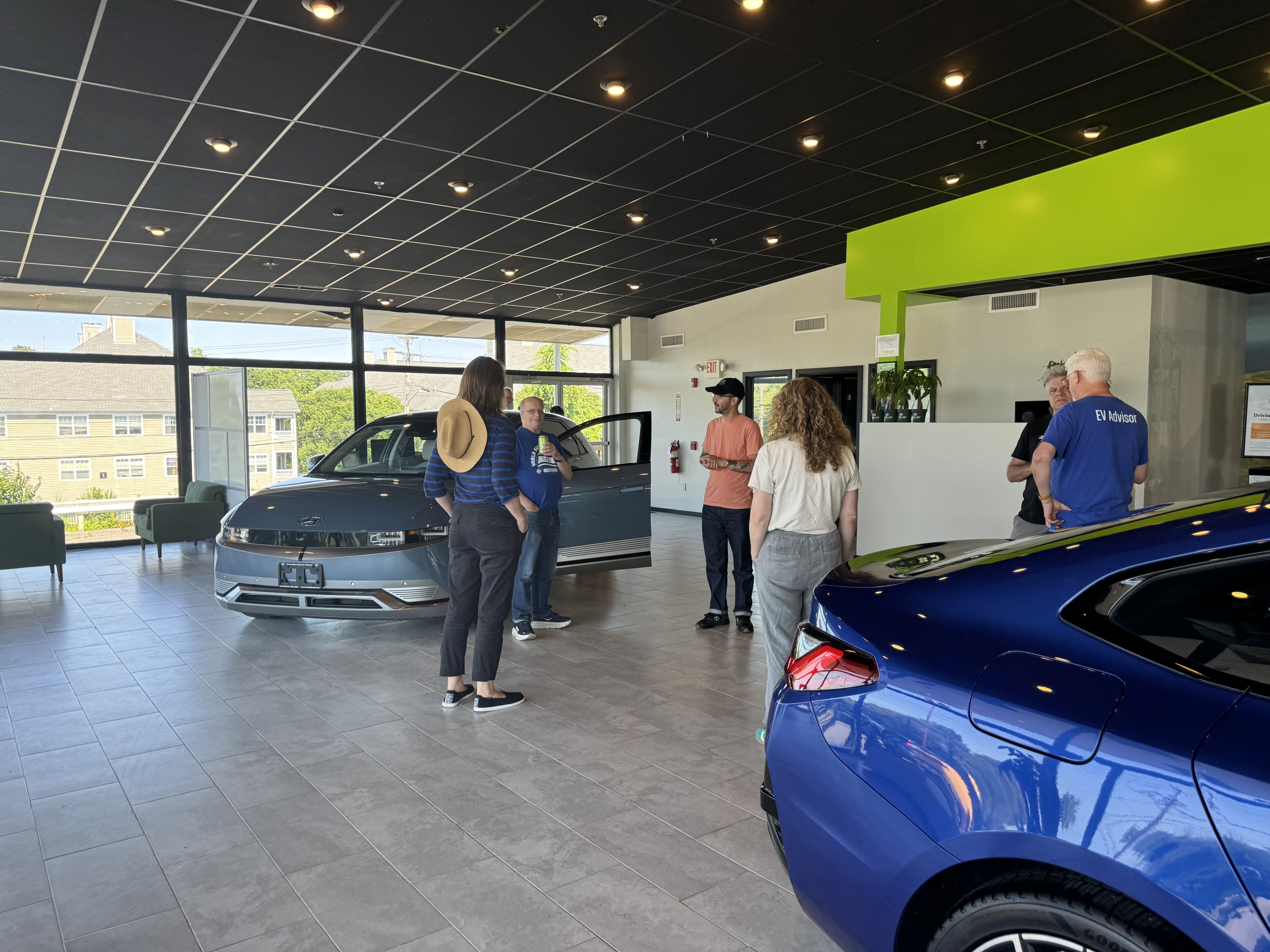
A few participants discussing EVs
After the presentation, Andrew, Green Wave’s Salem location manager, took guests for a tour of the Green Wave’s showroom, complete with countless plants, a backdrop depicting solar and wind energy, and three stunning electric vehicles.
Conclusion
When it comes to electric vehicles, public education is an often overlooked component. Green Wave works to help potential buyers of EVs learn about and choose the best EVs for their lives. Green Wave allowing for SAFE to hold this event at their location aligns with their mission to share information with the public about EVs. SAFE supports knowledge-sharing with the community about ways to reduce personal emissions through green technology and lifestyle changes. On the Green Energy Consumers Alliance home page of their website, they list 3 things as what they do: educate consumers, enable green energy choices, and advocate for the environment. By supporting local events like ours, they can support consumers in converting to an EV. The incentives offered are powerless if communities are not provided with essential knowledge and guidance required to feel confident and safe using them. There is still so much work to be done in ensuring that electric vehicles are not locked to one demographic or income bracket, but events like this shift the narrative and help us accomplish our goals. Electric vehicles are becoming far more affordable, more understood, and with any luck, will continue to do so.
Watch the recording of the entire presentation and the following Q&A below:
Thanks so much to Green Wave Electric Vehicles for the use of their space and for sharing their extensive knowledge on electric vehicles, and to the Green Energy Consumers Alliance for hosting an informative presentation for SAFErs.

