
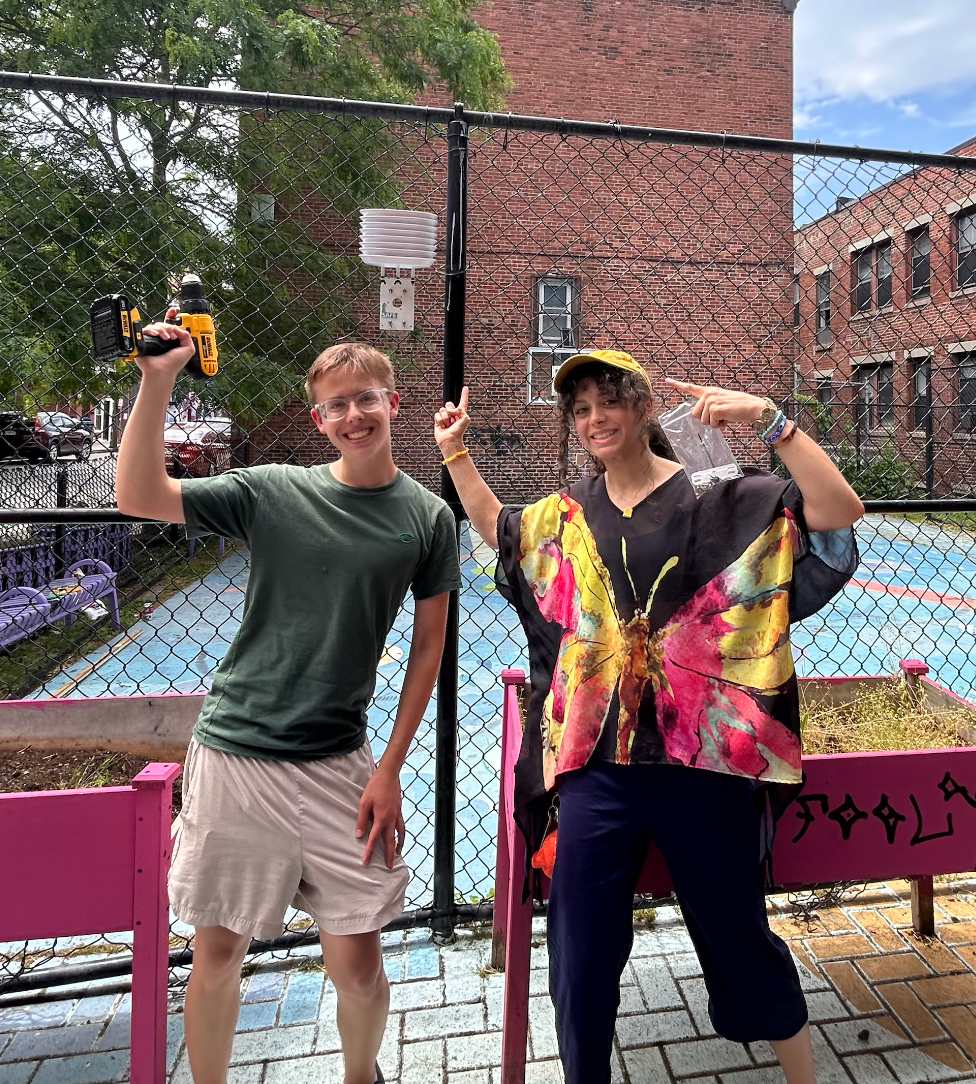

First install at Mack Park Food Farm! From left to right: Roshan of Drizzle Ranch, Ward 6 Councilor Katelyn Holappa, Gordon of Mack Park Farm, and SAFE programs intern Rylan
Over the past couple of weeks, SAFE and community volunteers have been hard at work, installing and assembling heat monitors. These monitors, installed in public areas, will allow residents to see how temperature changes based on shade, green spaces, and the surface below.
The monitors were installed at Mack Park Food Farm, 17 Ward Street, Mary Jane Lee Park, Palmer Cover Park, St. Peter’s Church, and on Congress Street. These installs, join the two installations from last summer located at 96 Lafayette St and at Salem State University.


Second install at Ward Street’s painted basketball court! Left image, from left to right: Councilor at Large Kyle Davis, local engineer Minnie, SAFE programs intern Rylan Workman, and Salem Youth Commission Member Alexia Coleman. Right image, from left to right: Rylan Workman and Alexia Coleman.

The team at the installation for the heat monitor at Saint Peter’s San Pedro’s Church. From left to right: Councilor at Large Alice Merkl, Reverend Nathan Ives, SAFE’s programs intern Rylan Workman, and Ward 2 councilor Andrew Smith. Also there but not pictured: SAFE’s Executive Director Bonnie Bain and SAFE’s communications intern Amanda Birenbach.


From left to right, Ward 5 Councilor Lydia King, SAFE Programs Intern Rylan Workman and SAFE Executive Director Bonnie Bain install the heat monitor at Palmers Cove Park.
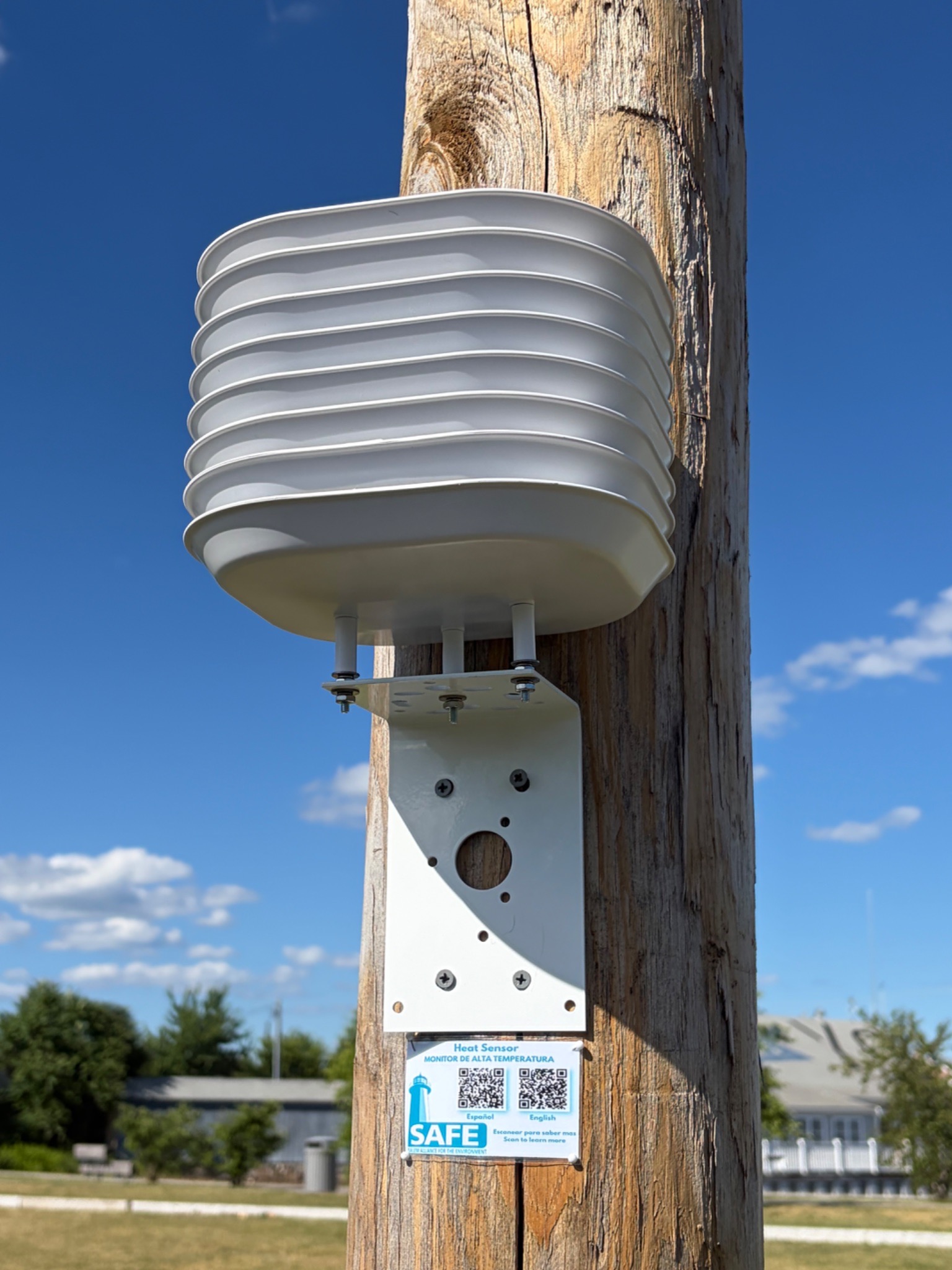
Palmers Cove heat sensor with the QR code information card beneath it.
The Need
Salem residents in neighborhoods with low amounts of tree cover and a high quantity of impervious surfaces might experience temperatures significantly higher than predicted. Impervious surfaces, particularly those that are colored black or grey, absorb heat readily, raising the area’s temperature. This is commonly referred to as the Urban Heat Island Effect.

Extreme heat is dangerous for health, particularly for children and the elderly. High heat results in approximately 12,000 premature deaths each year in the United States.1. If we can better predict which areas in Salem will be the hottest using our data, we can better distribute resources like cooling kits, fans, and information on energy savings to residents.
The Project’s Goals
SAFE hopes to utilize the research from these heat sensors to contribute to a deeper understanding of how local heat varies across Salem neighborhoods and locations that have shade and cooling elements, and those that do not.
Additionally, this project attempts to increase community awareness and involvement with high heat. We have utilized volunteers in our installation process, including youth, community members, and five city councilors. Salem residents will be able to use an app (HOBOConnect) to connect with their local monitor. This will allow them to visualize the hourly temperature in their neighborhood.

Ongoing Heat Sensor Map – zoomed out view of whole area

Ongoing Heat Sensor Map – zoomed in section for cluster of sensors in The Point neighborhood
Future Installations
Many thanks to our partnership with North Shore Community Development Coalition (NSCDC), The City of Salem, the Metropolitan Area Planning Council (MAPC), and Salem State University (SSU) Professor Nicholas Geron for the continued work on high heat. We are grateful to the Barr Foundation for supporting all of our efforts this summer to address high heat in our community, particularly in our most densely populated Environmental Justice neighborhood.
Sources
- Shindell, Drew, et al. “The Effects of Heat Exposure on Human Mortality Throughout the United States.” Geohealth, 2020. https://pmc.ncbi.nlm.nih.gov/articles/PMC7125937/. Accessed 12 June 2026.