
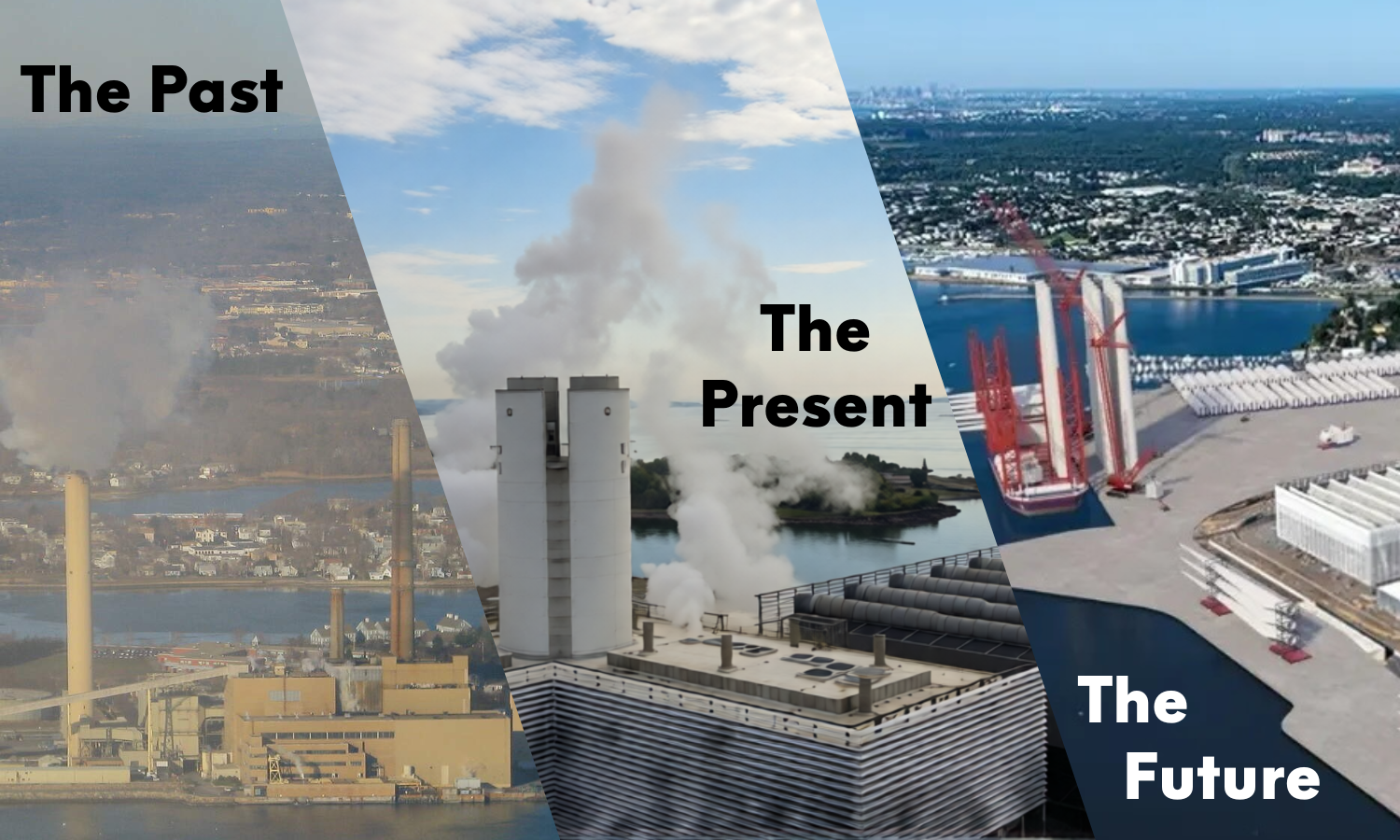
A waterfront built on coal

Original coal powered Salem Harbor Power Station (DeSmog)
Salem’s waterfront was once an active seaport, its 65-acre power-plant site reclaimed from the harbor in the 1800s and long used as a wharf and coal depository. For more than sixty years after that, it ran on coal. The Salem Harbor Power Station, a 748 MW coal plant, operated from 1951 until 2014, and it left a mark people still remember: smoke rising from its smokestacks, a haze of coal smog hanging over the harbor, black dust coating porches on Derby Street, and grit that residents wiped from their windows across the city. It was one of Massachusetts’ “Filthy Five,” the state’s dirtiest power stations. Tightening Clean Air Act rules and cheaper competing energy finally shut it down in 2014, and it was demolished in 2016.
The health toll was severe. A 2000 Harvard study by Jonathan Levy and John Spengler tied the plant’s emissions, including nitrogen oxides, sulfur dioxide, mercury, and fine particulate matter, to an estimated 14,000 asthma attacks and 53 premature deaths every year across a region stretching more than 30 miles. Particulate matter is especially dangerous because the smallest particles slip past the lungs’ defenses, enter the bloodstream, and damage vital organs, contributing to heart disease, bronchitis, and death.

The negative health impacts attributable to fine particle pollution from Salem Harbor power plant (Per Year) with estimated valuation (Data from the Harvard study, visualized by SAFE 2026)
That burden did not fall evenly. Salem is one of only 20 Massachusetts municipalities that contain neighborhoods meeting all four state criteria for environmental justice designation, based on income, race, and English-language proficiency. The Point/El Punto neighborhood, just inland from the harbor and the power station, met every criterion as soon as the state began designating environmental justice communities in 2002, and it had surely qualified long before. Salem breathed the pollution while much of the region simply enjoyed the power.

Map of the 2002 MA EJ community designations with the 2002 requirements for each designation (Data from MA’s EEA 2002, visualized by SAFE 2026)

Salem’s current environmental justice populations as of 2020, with the 2020 requirements for each designation (Imagery from EEA’s Environmental Justice Neighborhoods 2022, layout by SAFE 2026)
Why we exist
We were founded in 2001, in the shadow of September 11th and its aftermath. For folks at the founding table, Pat Gozemba, Karen Kahn, and Rev. Jeff Barz-Snell, that moment laid bare how deeply the country’s dependence on fossil fuels was bound up with geopolitical conflict and war. SAFE’s purpose was to shut down the Salem Harbor coal plant and help shift the country off of fossil fuels. From the start, we also held a vision for what should replace coal: renewable energy and offshore wind.
A connection across the world: shared environmental injustice
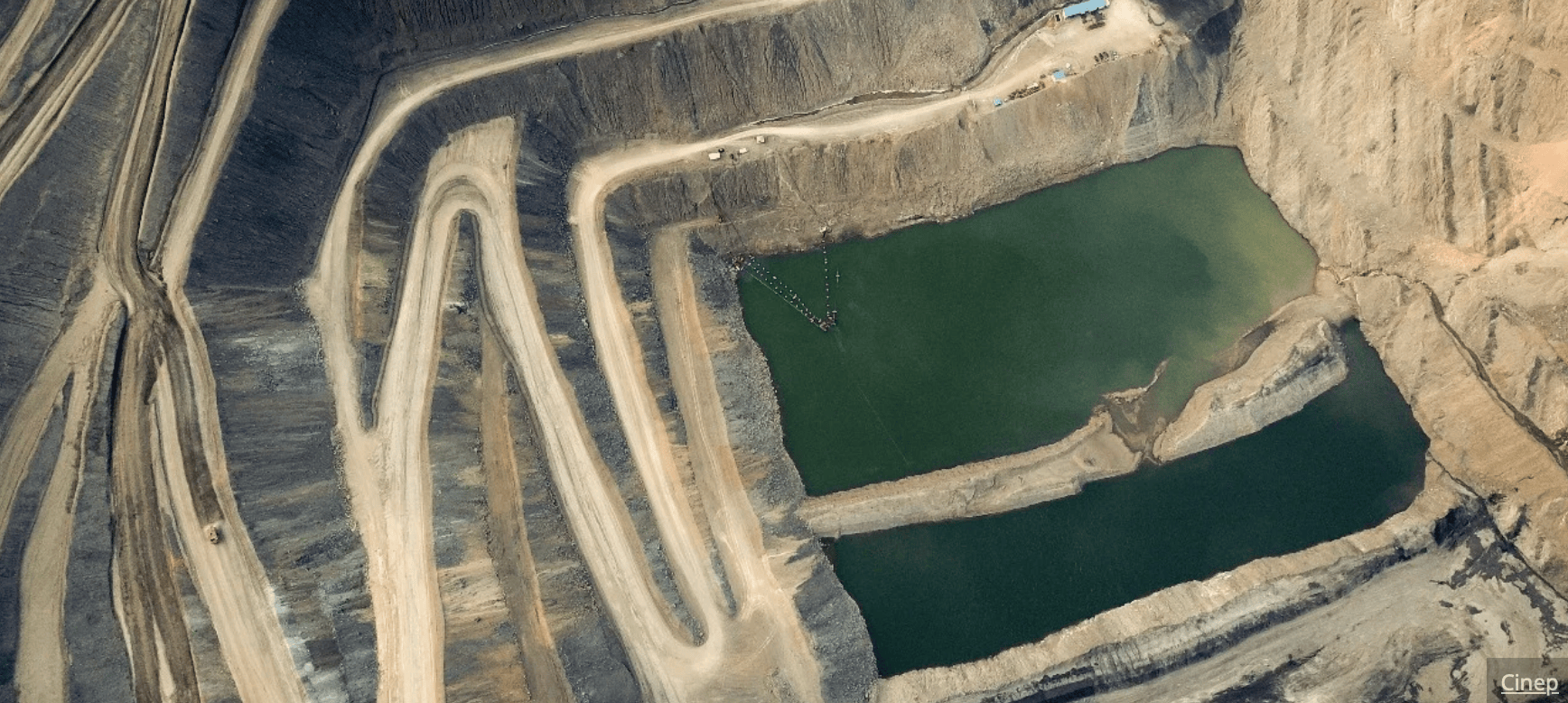
Image of the Cerrejón mine (Business and Human Rights Centre 2022)
Salem, home to one of the largest Latino and immigrant communities on the North Shore, was tied through that same coal to people suffering at the other end of the supply chain. The coal came from the Cerrejón open-pit mine in La Guajira, Colombia, one of the largest in the world, where mining violently displaced thousands of Wayúu, Campesinos, and Afro-Colombians and razed the village of Tabaco. The mine consumed and contaminated enormous quantities of water, leaving toxic metals like mercury and lead in local people’s blood. Recognizing that Salem’s own working-class and immigrant neighborhoods were bound to those Colombian communities, both bearing environmental injustice at opposite ends of the same coal chain, Salem and La Guajira began working in solidarity in 2002. Salem State Professor Avi Chomsky founded the North Shore Colombian Solidarity Committee, bringing Colombian leaders like José Julio Pérez to Salem, and the City Council passed a resolution supporting Tabaco’s displaced residents.
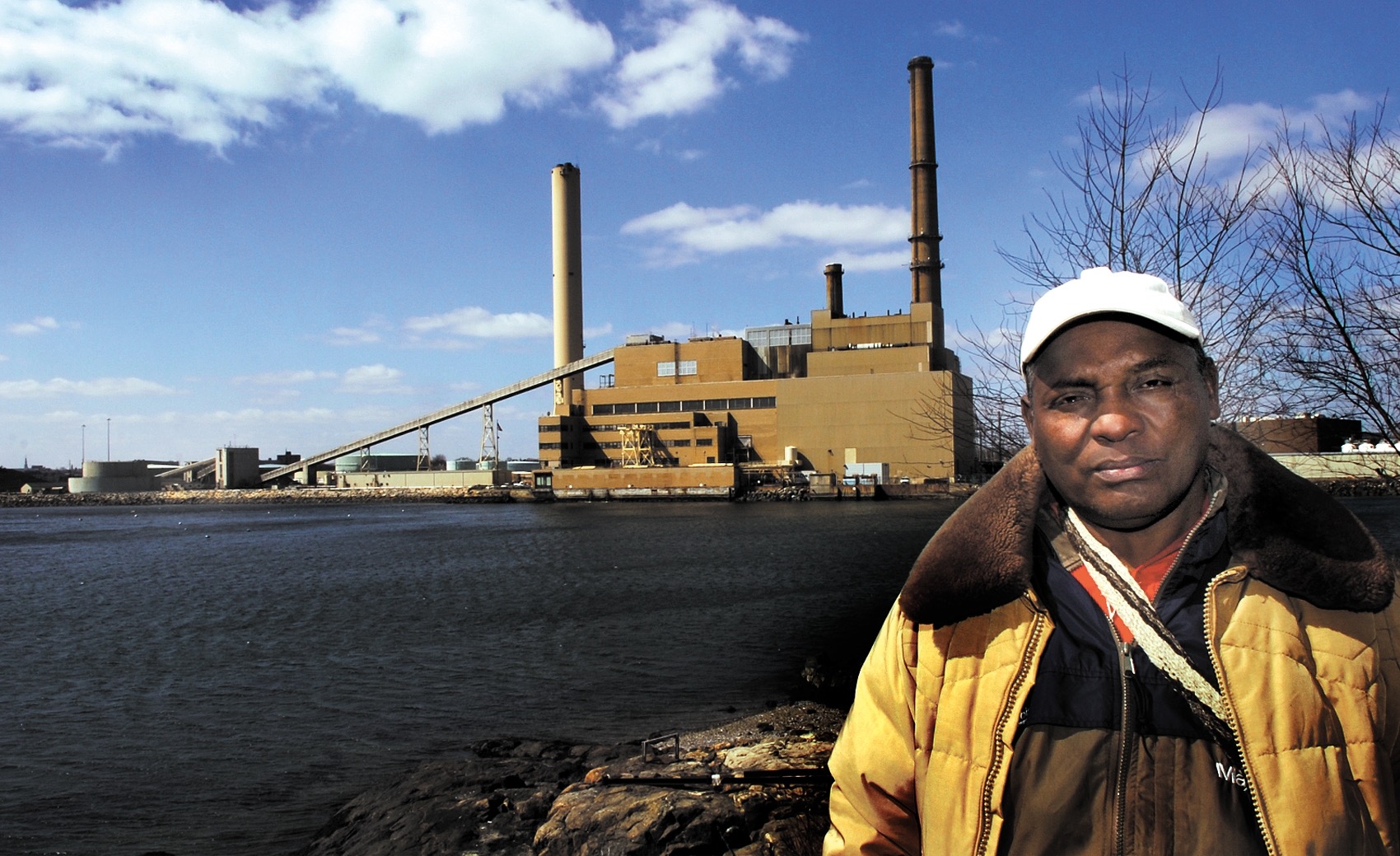
José Julio Pérez near the old coal power plant (Image provided by Avi Chomsky)
A gas peaker plant replaces the coal plant
The coal plant was replaced in 2018 by a natural gas “peaker” plant, which runs only during peak demand. It burns cleaner than coal, but it still burns fossil fuel. Its combustion of methane emits CO2, particulate matter, NOX, and SO2, and methane itself is a far more potent greenhouse gas than CO2. A 2012 study found that once leakage passes roughly 3.2% of total production, gas can rival or exceed coal’s climate impact. And like coal, gas ties Salem to harm at the source. The gas is hard to trace once it enters the pipeline network, but Salem State Professor Noel Healy and his fellow researchers found it most likely comes from Pennsylvania shale, the top natural-gas producing region in the country, reaching Salem by pipeline. There, fracking has left a radioactive-waste problem: in 2023, radioactivity alarms were triggered more than 550 times at Pennsylvania landfills because of oil and gas waste. The peaker plant in Salem is not slated to close until 2050, which we argue is far too late for a city that has already absorbed decades of pollution from the fossil fuels that power the region.
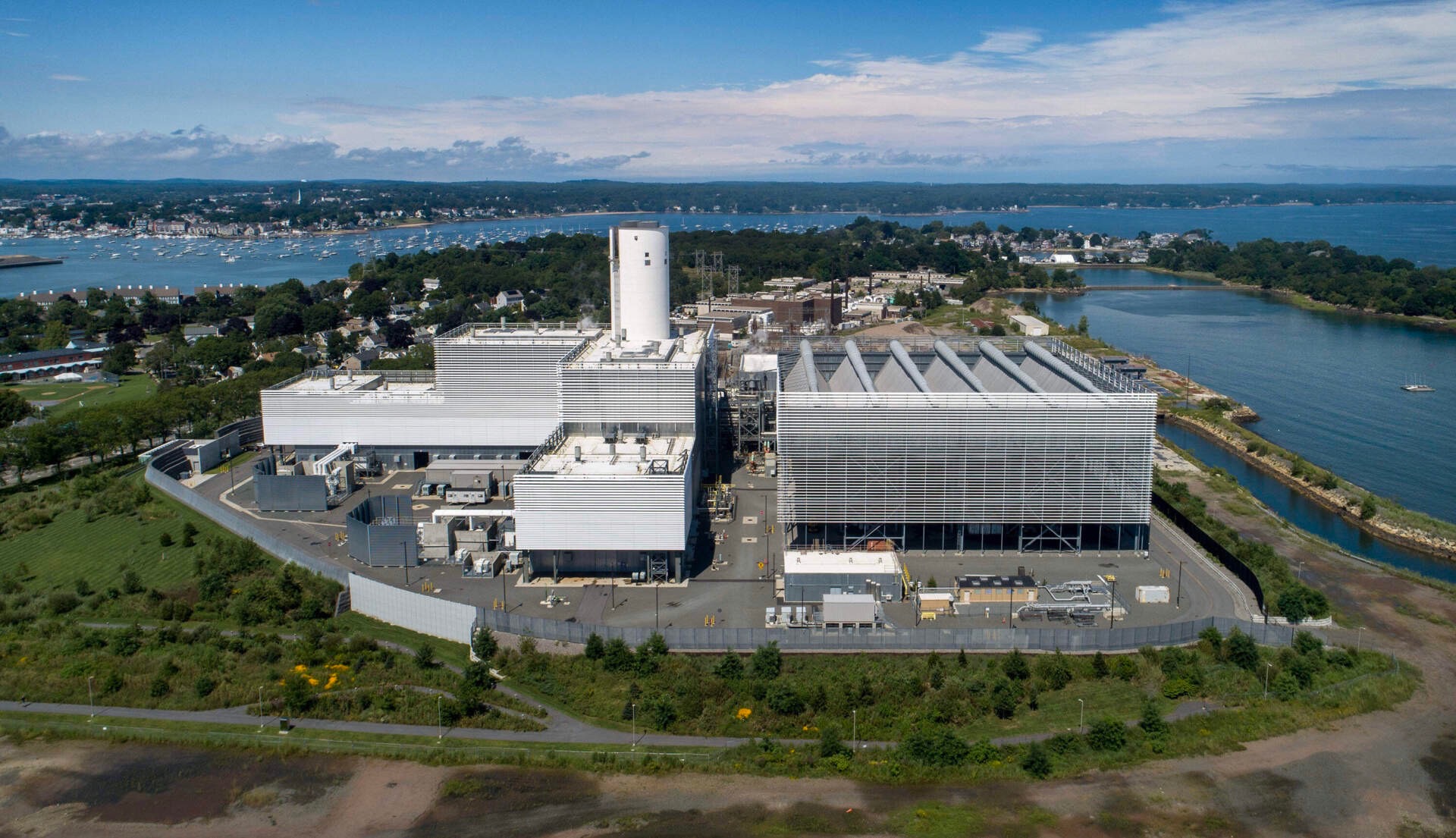
Salem Natural Gas power plant, facing the Salem Channel and Beverly (Taken by Robin Lubbock/WBUR (Wasser)
The future: an offshore wind terminal
Surrounding the peaker plant are roughly 42 acres of undeveloped land and a deep-water port. In 2021, a federal push for East Coast offshore wind made that waterfront a strong candidate for a new use. Crowley Wind Services moved to develop the site as a staging and marshalling terminal for assembling and maintaining turbines, not a wind farm off Salem. We have envisioned offshore wind here since our founding, and we support the terminal as the clean-energy future we fought for; however, ships and cargo equipment still run on diesel, concentrating pollution in port-adjacent neighborhoods. The key to keeping the terminal from repeating that harm is electrification.
A 2025 Tufts study by master’s students Sebastian Barajas Ortiz and Angelica Cheng and PhD candidate Bridget Moynihan, advised by Professor Eric Hines, examined shore power, which lets docked vessels plug in and shut off their engines, along with electric terminal equipment. The barriers are standardization, grid capacity, and cost, but the payoff is proven. The Port of Long Beach cut diesel particulate matter by 90%, NOX by 62%, and SO2 by 97%. Researchers also stress public power and community ownership, and in Salem much of it is already public: the Massachusetts Clean Energy Center (MassCEC) owns the 42-acre terminal site, the City of Salem owns the 5-acre berth parcel, and Crowley leases and operates the port. That public stake is also reflected in the Community Benefits Agreement that we helped shape with the Salem Offshore Wind Alliance. Progress has stalled, though. The Trump administration cut $34 million in federal funding, and as of August 2026 ground has not been broken, but state funding and a multi-state legal challenge may revive it.

Rendering of the proposed Crowley-Salem Offshore Wind Terminal (The Patch 2022)
What we’re doing now: air quality monitoring
With free monitors from MassDEP, SAFE and our friends at the North Shore CDC are installing 10 air quality monitors to track fine particulate matter and other pollutants from the gas plant, port, and nearby traffic. Unlike the coal plant’s visible smog, this pollution is largely invisible, since fine particulate matter is far too small to see. Monitoring it is how we make it visible. The monitors sit near the port and in surrounding neighborhoods, including the largely Spanish-speaking El Punto community, at locations chosen alongside Salem State University’s Geography and Sustainability Department and its Center for Entrepreneurship, Economic Development and Sustainability (CEEDS). The city added 5 more at public schools. This fall, we will work with Dr. Marcos Luna of Salem State’s Geography and Sustainability Department to build a bilingual dashboard for residents. The goal is to establish a clear baseline of local air quality, develop a publicly accessible resource for the community, and record future air impacts.
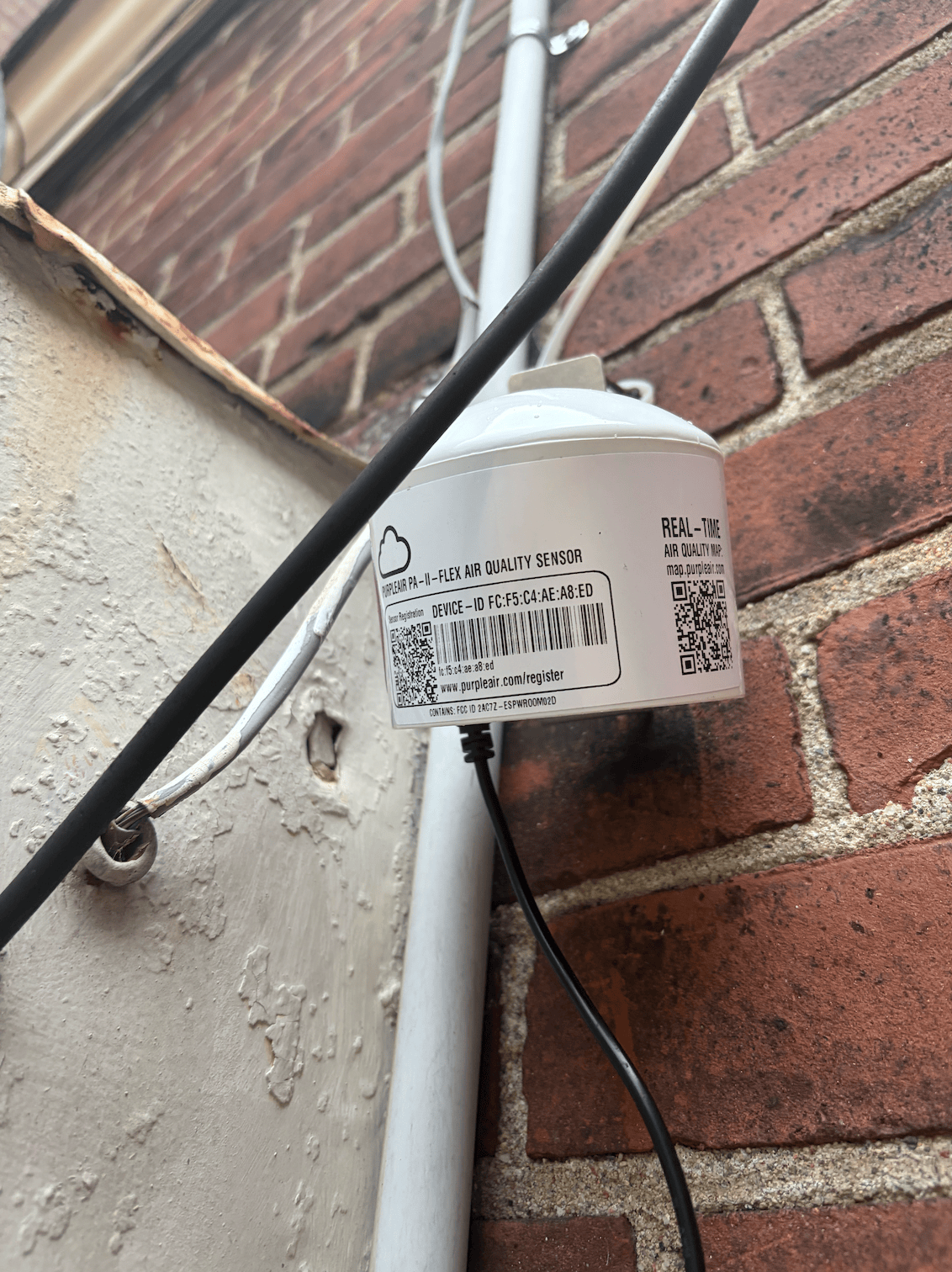
An air quality monitor behind the Northshore CDC offices at 96 Lafayette St (Taken by SAFE 2026)
A special thanks to Professor Noel Healy for providing us with his report and for helping us get the necessary information for this blog. Professor Healy is a Professor of Geography and Sustainability at Salem State University and was a recent recipient of the university’s 2026 Distinguished Teaching Award. His admirable commitment to climate advocacy and justice led him to become the director of the Climate Justice and Just Transformations Lab. More information on Professor Healy can be found here.
Additionally, we want to thank Tufts University and their two amazing researchers, PhD Candidate Bridget Moynihan and Master’s students Sebastian Barajas Ortiz and Angelica Cheng, for their contributions to our knowledge of port electrification and public power. They have been instrumental in ensuring SAFE has credible and reliable information on the wind port project.
Last but not least, we would like to thank Salem State Professor Avi Chomsky for providing the photo of José Julio Pérez near the old coal power plant and for reviewing this blog.